Ue, Ui and Uimp in MCCBs: What Do These Voltage Ratings Mean?
Por Jimmy Zheng · Revisado pela Equipe de Engenharia SSPD

Quick Answer: What Are Ue, Ui and Uimp in an MCCB?
Ue, Ui and Uimp are three different voltage ratings used to describe the electrical characteristics of a molded case circuit breaker (MCCB). Ue is the rated operational voltage, Ui is the rated insulation voltage, and Uimp is the rated impulse withstand voltage. Each represents a different aspect of electrical performance and insulation capability.
1. Why Do MCCBs Have Three Different Voltage Ratings?
When comparing molded case circuit breakers, buyers often notice three voltage values on the technical datasheet: Ue, Ui and Uimp.
For example, an AC MCCB may have the following specifications:
- Ue: 440V AC
- Ui: 690V
- Uimp: 6kV
At first glance, these values may seem to describe the same electrical characteristic. However, they represent three different requirements.
Ue determines the operational voltage for which the circuit breaker is rated. Ui provides the reference for its insulation characteristics and dielectric testing. Uimp indicates its ability to withstand specified transient voltage impulses.
Understanding these differences is important when selecting MCCBs for industrial distribution systems. Confusing insulation voltage with operational voltage, for example, may lead to selecting a breaker that cannot safely perform its intended switching and protection functions at the actual system voltage.
Let’s examine each parameter and how it affects MCCB selection.
2. What Is Ue in an AC MCCB?
Ue stands for Rated Operational Voltage. It is the voltage value assigned by the manufacturer to which the circuit breaker’s operating performance is referred, including its switching and short-circuit breaking performance.
For multipole AC circuit breakers used in three-phase systems, Ue is generally specified as the voltage between phases (line-to-line voltage).
Common AC system voltage levels include:
- 220/230V AC
- 380/400V AC
- 415V CA
- 440V CA
- 690V CA
Why Is Ue Important?
Ue is one of the first parameters to check when selecting an MCCB.
The rated operational voltage must be suitable for the actual electrical system. A breaker designed for a maximum operational voltage of 440V should not automatically be selected for a 690V application simply because its insulation voltage is higher.
Ue also affects the breaker’s short-circuit performance.
For example, an MCCB may have different Icu and Ics ratings at 400V, 440V and 690V. These values must be checked at the intended operating voltage rather than assumed to remain unchanged.
For industrial buyers, this means that checking the rated current alone is not sufficient. The rated operational voltage and corresponding breaking capacity must also match the installation requirements.
3. What Is Ui in an AC MCCB?
Ui stands for Rated Insulation Voltage.
It is the voltage value assigned by the manufacturer to which dielectric tests and creepage distances are referred.
In simple terms, Ui is related to the insulation design and testing of the circuit breaker, rather than the voltage at which it is intended to operate continuously.
How Does Ui Relate to Ue?
According to IEC low-voltage switchgear requirements, the maximum rated operational voltage must not exceed the rated insulation voltage.
The relationship is:
Ue ≤ Ui
For example, consider an MCCB with:
- Ue = 440V
- Ui = 690V
This means that its rated operational voltage is 440V, while its insulation characteristics are referenced to a rated insulation voltage of 690V.
It does not mean that the MCCB can operate at 690V.
Why Does Insulation Voltage Matter?
The insulation system of an MCCB must maintain adequate electrical separation between conductive parts.
Two important concepts are:
- Clearance: The shortest distance through air between two conductive parts.
- Creepage distance: The shortest distance along the surface of an insulating material between two conductive parts.
Ui is one of the important ratings used as a reference for evaluating insulation characteristics and dielectric test requirements.
When comparing MCCBs, buyers should therefore avoid assuming that a higher Ui automatically means a higher operational voltage or better overall breaking performance.
4. What Is Uimp in an AC MCCB?
Uimp stands for Rated Impulse Withstand Voltage.
It represents the peak value of a specified impulse voltage that the equipment can withstand without insulation failure under defined test conditions.
Unlike Ue and Ui, Uimp is expressed in kilovolts (kV).
Common MCCB impulse withstand voltage ratings include:
- 6kV
- 8kV
- 12kV
Why Is Uimp Important?
Electrical systems can experience transient overvoltages caused by events such as:
- Switching operations
- Lightning-induced disturbances
- Transient voltage changes in the distribution network
These events can produce short-duration voltage stresses that are significantly higher than the normal operating voltage.
Uimp indicates the specified impulse withstand capability of the MCCB insulation system.
It is particularly relevant to insulation coordination, which ensures that electrical equipment can withstand the transient overvoltages expected at its installation location.
Does Uimp Mean Lightning Protection?
N.º.
An MCCB with Uimp = 8kV is not a surge protection device.
It means that the equipment has a specified impulse withstand rating under defined test conditions. It does not mean that the MCCB limits surge voltage to 8kV or protects the entire electrical installation from lightning damage.
Surge protective devices (SPDs) perform a different function by limiting transient overvoltages.
Therefore, Uimp and SPD protection level (Up) should not be treated as interchangeable parameters.
5. Ue vs Ui vs Uimp: What Are the Differences?
The following table summarizes the main differences between the three voltage ratings.
| Parâmetro | Ue | Ui | Uimp |
|---|---|---|---|
| Nome completo | Rated Operational Voltage | Rated Insulation Voltage | Rated Impulse Withstand Voltage |
| Objetivo principal | Operational performance | Insulation reference | Transient withstand |
| Unit | V | V | kV |
| Principal preocupação | Tensão de operação | Insulation characteristics | Impulse voltage |
| Determines operating voltage? | Sim | Não | Não |
The key point is that these three ratings describe different electrical characteristics.
They should be evaluated together, but they cannot replace one another.
For MCCB selection, Ue determines whether the breaker is suitable for the intended operating voltage, Ui indicates its rated insulation level, and Uimp helps evaluate its ability to withstand transient voltage impulses.

6. How to Read Ue, Ui and Uimp on an MCCB Datasheet?
Understanding these ratings becomes easier when looking at actual MCCB product specifications.
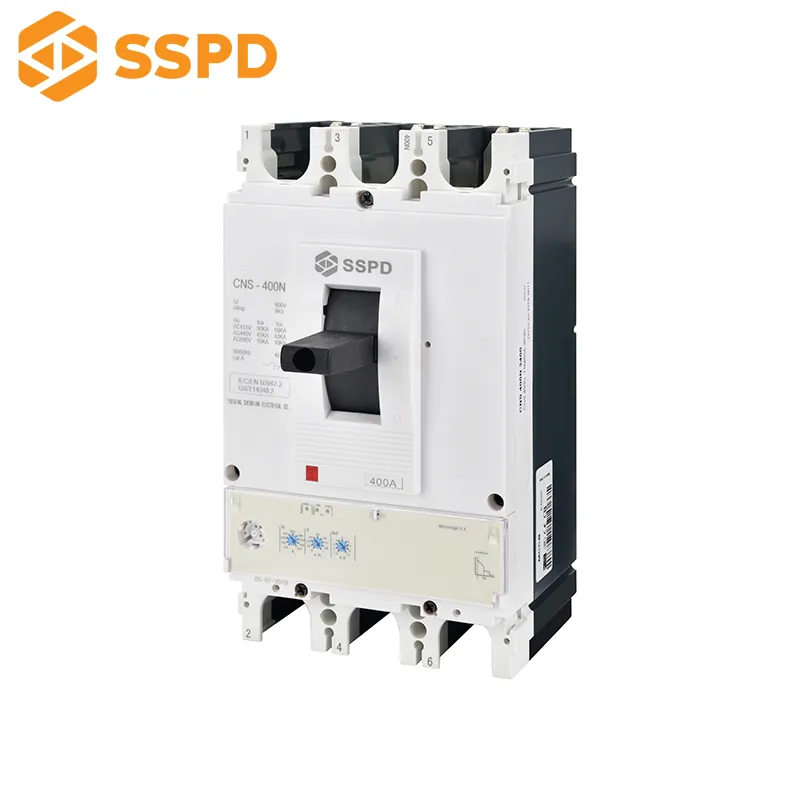
SSPD offers several AC MCCB series with different voltage configurations.
Here are three examples from the published product specifications.
Example A: SSPD CEZC MCCB
The CEZC series has the following voltage ratings:
| Parâmetro | Specification |
|---|---|
| Rated Operational Voltage (Ue) | 440V CA |
| Rated Insulation Voltage (Ui) | 690V |
| Rated Impulse Withstand Voltage (Uimp) | 6kV |
For this series, Ue is 440V AC, while Ui is 690V.
Although the insulation voltage is 690V, the rated operational voltage remains 440V.
Therefore, this model should not be selected for a 690V operating system based solely on its Ui value.
Example B: SSPD CNSV MCCB
The CNSV series provides another configuration:
| Parâmetro | Specification |
|---|---|
| Rated Operational Voltage (Ue) | 440V CA |
| Rated Insulation Voltage (Ui) | 690V |
| Rated Impulse Withstand Voltage (Uimp) | 8kV |
Compared with the CEZC series, the published Ue and Ui ratings are the same, while the Uimp rating is different.
This illustrates why Uimp should be evaluated independently rather than assuming that all voltage ratings increase together.
Example C: SSPD CNSD MCCB
The CNSD series is designed for applications with a higher rated operational voltage.
| Parâmetro | Specification |
|---|---|
| Rated Operational Voltage (Ue) | 690V CA |
| Rated Insulation Voltage (Ui) | 800V |
| Rated Impulse Withstand Voltage (Uimp) | 8kV |
This configuration demonstrates the difference between a breaker rated for 440V operation and one rated for 690V operation.
However, there is one additional point that engineers must check.
The currently published CNSD breaking-capacity table provides Icu and Ics values at 380/415V. These values must not be assumed to apply at 690V. The corresponding 690V breaking-capacity data should be confirmed for the specific model before selection.
What Can Buyers Learn from These Examples?
These three product series demonstrate an important principle:
A higher Ui or Uimp does not automatically mean that an MCCB has a higher Ue or better overall electrical performance.
When comparing different manufacturers or product series, always review the complete technical datasheet, including operational voltage, insulation voltage, impulse withstand voltage and breaking capacity.
7. How to Select the Right Voltage Ratings for an AC MCCB?
For industrial applications, MCCB selection should follow a systematic process rather than relying on one voltage parameter.
Here are five important steps.
Step 1: Identify the System Voltage
First, confirm the actual AC system voltage.
Por exemplo:
- 400V AC three-phase
- 415V AC three-phase
- 440V AC three-phase
- 690V AC three-phase
The system configuration and grounding arrangement should also be considered where relevant.
Step 2: Check the Rated Operational Voltage (Ue)
Select an MCCB with a rated operational voltage suitable for the electrical system.
For a 415V system, the selected MCCB must have an appropriate Ue rating and verified performance at that voltage.
Step 3: Verify the Rated Insulation Voltage (Ui)
Check that Ui is not lower than the maximum rated operational voltage.
Lembra-te:
Ue ≤ Ui
Do not use Ui as a substitute for the operational voltage rating.
Step 4: Evaluate the Rated Impulse Withstand Voltage (Uimp)
Consider the installation location, expected transient overvoltages and insulation coordination requirements.
The required Uimp should be appropriate for the electrical installation and applicable standards.
Step 5: Confirm Breaking Capacity and Other Ratings
Finally, check:
- Corrente nominal (In)
- Capacidade de interrupção máxima (Icu)
- Capacidade de interrupção de serviço (Ics)
- Número de postes
- Caraterísticas de proteção
- Condições de instalação
In particular, make sure the Icu and Ics values correspond to the actual operating voltage.
For more information, see our guide on Como escolher a capacidade de corte de um MCCB.
8. Common Mistakes When Comparing MCCB Voltage Ratings
Even experienced buyers can misunderstand voltage specifications when comparing different MCCB products.
Here are four common mistakes to avoid.
Mistake 1: Assuming Ui Determines the Operating Voltage
An MCCB with Ui = 690V does not necessarily have Ue = 690V. Always check the rated operational voltage.
Mistake 2: Treating Uimp as Continuous Voltage
Uimp represents impulse withstand capability, not the normal operating voltage of the circuit breaker.
Mistake 3: Ignoring Breaking Capacity at Different Voltages
Icu and Ics may change depending on the rated operational voltage. Always verify the values at the intended system voltage.
Mistake 4: Comparing MCCBs Based on One Parameter
A higher Uimp or Ui does not automatically make a circuit breaker better for every application. The complete electrical specification must be evaluated.
9. Frequently Asked Questions
1. What Is the Difference Between Ue and Ui in an MCCB?
Ue is the rated operational voltage, which defines the voltage at which the MCCB’s specified operating performance applies. Ui is the rated insulation voltage used as a reference for dielectric testing and creepage distances. Ue must not exceed Ui.
2. Does Ui 690V Mean an MCCB Can Operate at 690V?
No. Ui indicates the rated insulation voltage, not the rated operational voltage. For a 690V electrical system, the MCCB must have an appropriate Ue rating of at least 690V and verified breaking performance at that voltage.
3. What Does Uimp 8kV Mean in an MCCB?
Uimp = 8kV means the MCCB has a rated impulse withstand voltage of 8kV peak under specified test conditions. It describes the insulation system’s ability to withstand specified transient voltage impulses, not continuous operation at 8kV.
4. Is Uimp Related to Lightning Protection?
Yes, it is relevant to insulation coordination against transient overvoltages, including lightning-induced disturbances. However, Uimp is not a surge protection function. An MCCB does not replace an appropriately selected surge protective device.
5. Can an MCCB Have a Higher Ui Than Ue?
Yes. This is common in low-voltage circuit breakers. For example, an MCCB may have Ue = 440V and Ui = 690V. The higher Ui provides the rated insulation reference level, while the operational voltage remains 440V.
6. How Do I Choose the Correct Uimp Rating?
The required Uimp depends on the installation’s overvoltage category, expected transient overvoltages and insulation coordination requirements. Buyers should consult the applicable IEC requirements and the equipment manufacturer’s technical documentation.
7. Does MCCB Breaking Capacity Change with Ue?
It can. An MCCB may have different Icu and Ics ratings at different operational voltages. Always check the manufacturer’s breaking-capacity table for the exact operating voltage and product configuration.
10. Summary
Ue, Ui and Uimp describe three different voltage characteristics of an AC MCCB: operational voltage, insulation voltage and impulse withstand voltage. Understanding their differences helps buyers avoid incorrect product selection and compare circuit breakers more accurately. Always verify the complete datasheet, especially the operational voltage and corresponding breaking capacity, before choosing an MCCB for an industrial application.
Sobre o Autor
Jimmy Zheng
Gerente de Negócios Internacionais na SSPD
Jimmy Zheng has over 10 years of experience in low-voltage electrical products and international B2B business. He works with electrical distributors, switchgear manufacturers and industrial buyers, focusing on MCCB, ACB, MCB and electrical protection solutions.
His articles share practical insights from international sourcing, product selection and low-voltage electrical applications.
Revisão Técnica: Equipe de Engenharia SSPD
This article is reviewed for technical accuracy, product specifications and applicable low-voltage electrical standards.