How an Air Circuit Breaker Works:
Step-by-Step Operating Principle Explained**
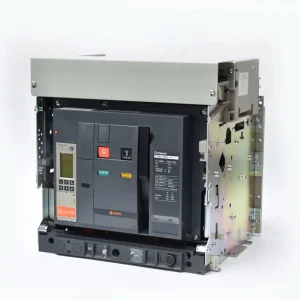
An air circuit breaker (ACB) protects low-voltage power systems by detecting abnormal current conditions and safely interrupting the circuit. Below is a clear, engineering-oriented explanation of only the working principle, without product introductions or background theory.
1. Continuous Current Monitoring
During normal operation, current flows through the main contacts.
The trip unit continuously monitors electrical parameters such as:
-
Current magnitude
-
Time duration
-
Fault characteristics
This monitoring runs in real time and does not affect normal power flow.
2. Fault Recognition
When an abnormal condition occurs—typically:
-
Overload
-
Short circuit
-
Ground fault
the trip unit instantly compares the detected current against preset thresholds.
Once the fault logic is satisfied, a trip command is issued.
3. Mechanical Tripping & Contact Separation
After receiving the trip signal:
-
The operating mechanism releases stored mechanical energy
-
Moving contacts separate rapidly from fixed contacts
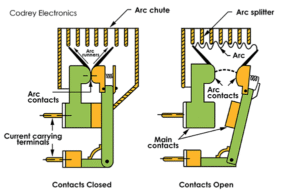
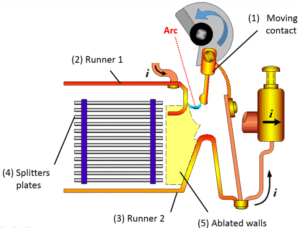
Because current is still flowing at the moment of separation, an electric arc forms between the contacts.
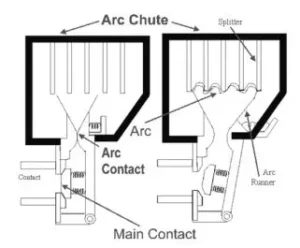
4. Arc Control and Arc Movement
The arc is immediately driven away from the contacts by:
-
Electromagnetic forces generated by the fault current
-
Arc runners that guide the arc upward
This movement prevents excessive contact erosion and concentrates the arc inside the arc-extinguishing system.
5. Arc Extinguishing in Air
Inside the arc chute:
-
The arc is split into multiple smaller arcs
-
Arc length increases, reducing arc energy
-
Air absorbs heat and de-ionizes the arc path
As ionization decreases, the arc voltage rises beyond the system voltage, causing the arc to extinguish naturally.
6. Full Circuit Interruption
Once the arc is fully extinguished:
-
Current flow stops completely
-
The circuit is safely isolated
-
Downstream equipment is protected from thermal and mechanical damage
The breaker remains in the tripped position until manually or electrically reset.
7. Reset and Re-closure (After Fault Clearance)
After the fault cause is eliminated:
-
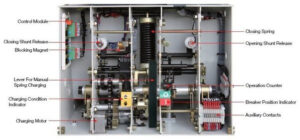
The operating mechanism is recharged
-
Contacts return to the closed position
-
Normal current flow resumes
This reset process ensures repeatable protection without replacing components.
SSPD Design Focus (Applied Principle)
In SSPD air circuit breakers, the working principle above is reinforced by:
-
Optimized arc-chute airflow design for faster de-ionization
-
Reinforced contact systems to withstand repeated high-fault interruptions
-
Stable trip accuracy to ensure predictable coordination in distribution systems
The goal is simple: fast interruption, controlled arcing, and reliable isolation—every time a fault occurs.