Fixed vs Adjustable MCCB: What Is the Difference and Which Should You Choose?
By Jimmy Zheng | Reviewed by SSPD Engineering Team
Quick Answer: Fixed vs Adjustable MCCB
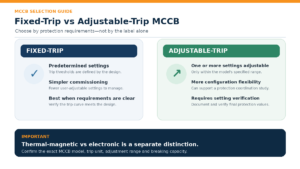
A fixed-trip MCCB uses predetermined protection settings, while an adjustable-trip MCCB allows one or more protection parameters to be changed within a specified range. Fixed-trip models can simplify selection and commissioning, while adjustable-trip models offer greater flexibility for protection coordination and changing load requirements. The right choice depends on the electrical system, not simply the rated current or purchase price.
What Is a Fixed-Trip MCCB?
A fixed-trip molded case circuit breaker (MCCB) has predetermined trip characteristics that cannot be freely adjusted by the user. When the current exceeds the applicable protection threshold under the specified operating conditions, the breaker trips and interrupts the circuit.
Most fixed-trip configurations provide overload and short-circuit protection through a thermal-magnetic trip mechanism. The thermal element responds to sustained overloads, while the magnetic element responds to high fault currents.
The main advantage of a fixed-trip MCCB is simplicity. When the electrical design, load characteristics and protection requirements are clearly defined, a predetermined trip characteristic may provide the required protection without additional adjustment during commissioning.
Fixed-trip MCCBs can be suitable for:
- Standard distribution feeders with established protection requirements.
- Electrical panels using consistent, predefined circuit configurations.
- Cost-sensitive projects where adjustable settings are unnecessary.
- Wholesale applications requiring standardized product specifications.
However, fixed-trip does not mean that the breaker is suitable for every circuit within its rated current range. Engineers must still verify the trip characteristics, cable protection requirements, available short-circuit current and coordination with upstream and downstream devices.
A fixed-trip MCCB is a practical choice when its predefined protection characteristics satisfy the electrical design.
What Is an Adjustable-Trip MCCB?
An adjustable-trip MCCB allows one or more protection parameters to be modified within a range specified by the manufacturer. Depending on the trip unit, these adjustments may include overload pickup current, short-circuit pickup current or other protection settings.
For example, an electronic trip unit may provide an adjustable long-time pickup setting, commonly designated Ir, and a short-time pickup setting, commonly designated Isd, when the relevant functions are available.
These settings serve different purposes. Adjusting the overload pickup can help match the protection characteristics to the circuit’s operating requirements. Adjusting short-circuit protection can help engineers coordinate protective devices, provided that the resulting settings remain within safe and permissible limits.
Not every adjustable MCCB offers the same functions. Some thermal-magnetic designs provide limited adjustment, while electronic trip units may offer more extensive setting options. The available functions depend on the exact model and trip-unit configuration.
Adjustable-trip MCCBs can be useful when:
- Different feeders require different protection settings.
- Selective coordination between protective devices is important.
- The electrical design requires adjustable overload or short-circuit thresholds.
- Commissioning requires settings to be matched to verified system calculations.
Adjustability introduces additional responsibilities. Engineers must select appropriate settings, document them and verify that the resulting protection remains effective. Raising a trip threshold simply to prevent nuisance tripping can expose cables and equipment to unacceptable risks.
Fixed vs Adjustable MCCB: Key Differences
The following comparison explains how the two configurations differ in practical applications.
| Factor | Fixed-Trip MCCB | Adjustable-Trip MCCB |
|---|---|---|
| Protection settings | Predetermined for the relevant trip functions | One or more settings can be adjusted within specified limits |
| Selection | Simpler when requirements are clearly defined | Requires confirmation of adjustment ranges and protection requirements |
| Commissioning | Usually requires fewer setting decisions | May require setting calculations, verification and documentation |
| Protection coordination | Suitable when its fixed characteristics meet coordination requirements | Offers more flexibility when settings must be coordinated |
| Load changes | May require reassessment or equipment replacement | May accommodate certain changes through permitted adjustments |
| Maintenance | Verify performance and condition according to the maintenance plan | Also maintain accurate records of protection settings |
| Purchase cost | Often economical for straightforward applications | May cost more depending on trip-unit features and configuration |
These are general tendencies rather than universal rules. Actual cost, performance and functionality depend on the product design and specifications.
One distinction is particularly important: fixed-trip versus adjustable-trip does not mean thermal-magnetic versus electronic. A thermal-magnetic MCCB may have adjustable settings, and an electronic trip unit may have its own defined adjustment limits. Buyers should compare the actual trip characteristics rather than relying on these labels alone.
How SSPD CEZC and CNSX MCCBs Fit Different Protection Requirements
SSPD offers CEZC and CNSX molded case circuit breaker series for low-voltage distribution applications. Their product configurations provide useful examples of why buyers should evaluate the trip unit and model specifications rather than treating an entire series as exclusively fixed-trip or adjustable-trip.
SSPD CEZC MCCB: Practical Options for Distribution Applications
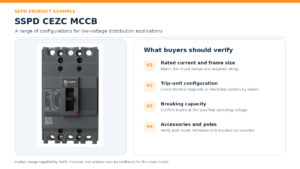
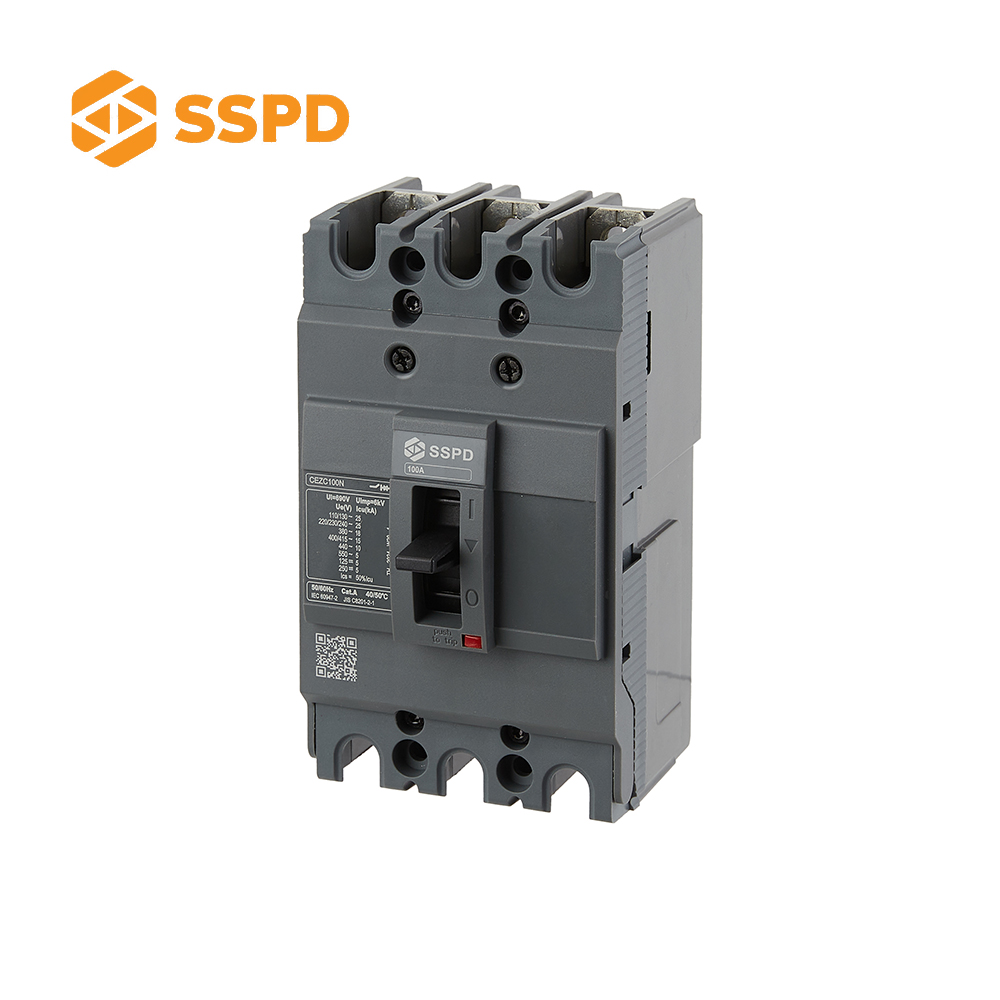
The SSPD CEZC MCCB series covers rated currents from 15A to 630A, with different frame sizes, pole configurations and breaking-capacity options.
The published product information lists thermal-magnetic protection for CEZC100 and CEZC250 configurations. For CEZC400 and CEZC630, the product information also lists electronic trip configurations alongside thermal-magnetic options.
This distinction matters when selecting a product.
For a standard feeder with clearly defined protection requirements, a suitable CEZC configuration with predetermined trip characteristics may be sufficient. If the application requires adjustable protection parameters, buyers should examine the relevant CEZC model and verify the available trip-unit functions and adjustment ranges.
The CEZC series should therefore be evaluated by its specific model and configuration, not simply described as a fixed-trip product.
SSPD CNSX MCCB: Check the Exact Trip-Unit Configuration
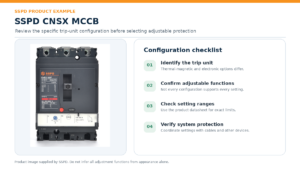
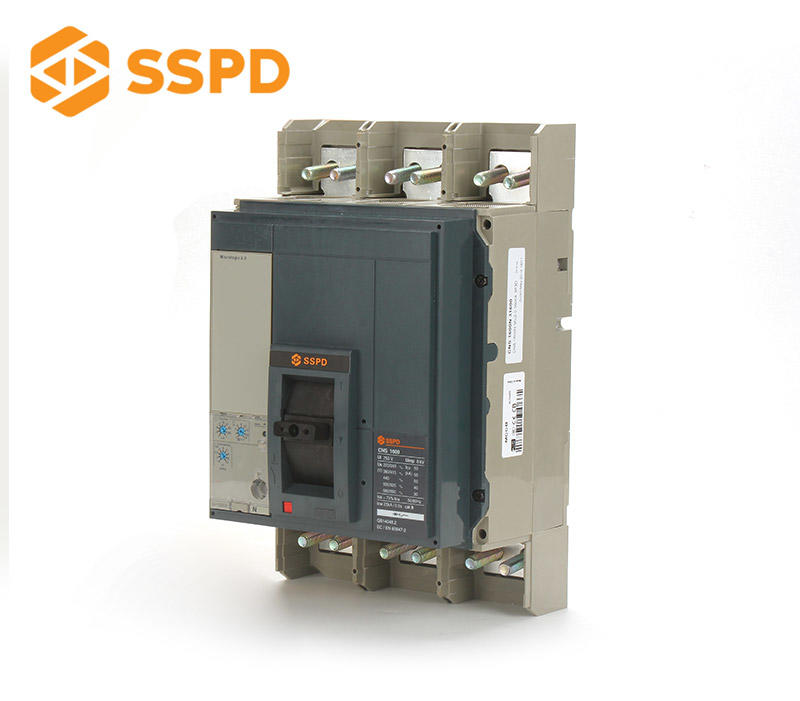
The SSPD CNSX MCCB series covers rated currents from 16A to 630A. The published product range includes 100A, 160A and 250A frame groups, as well as 400A and 630A configurations.
The CNSX product documentation provides model-specific technical information, including rated voltage, breaking-capacity levels, connection arrangements and protection characteristics. Where different trip-unit options are offered, the exact configuration must be confirmed before ordering.
For a buyer comparing CNSX options, the key questions are:
- Is the required protection setting fixed or adjustable?
- Which overload and short-circuit protection functions are available?
- What adjustment ranges are provided by the selected trip unit?
- Does the breaking capacity meet the project’s requirements at the specified voltage?
- Are the required accessories and connection arrangements available?
The CNSX range should not automatically be treated as adjustable in every configuration. Confirming the specific model and trip-unit specification is essential.
Which SSPD Series Should You Consider?
CEZC and CNSX should be compared according to the application rather than ranked solely by series name.
A distributor purchasing standard MCCBs may prioritize consistent specifications, cost and stock planning. A switchgear manufacturer may place greater emphasis on trip-unit options, connection arrangements and protection coordination. An EPC contractor may need a complete technical review against the project specification.
SSPD’s CEZC and CNSX ranges provide different configurations to evaluate against these requirements. The correct choice depends on the actual electrical design and confirmed product data.
When Should You Choose a Fixed-Trip MCCB?
A fixed-trip MCCB is worth considering when the circuit requirements are clearly established and the predefined protection characteristics satisfy the design.
For example, a distribution panel may contain several standard feeders with known loads and verified cable ratings. If the selected MCCB provides adequate overload and short-circuit protection and meets the coordination requirements, additional adjustment capability may offer little practical benefit.
Fixed-trip configurations can also simplify procurement. Distributors handling standardized products may find it easier to manage stock and replacement requirements when specifications are consistent.
Before selecting a fixed-trip MCCB, confirm:
- The rated current and relevant trip characteristics.
- Cable ampacity and applicable overload-protection requirements.
- The available short-circuit current at the installation point.
- The MCCB’s breaking capacity at the operating voltage.
- Coordination requirements with other protective devices.
A fixed-trip model is not automatically the cheaper choice over the product’s entire service life, nor is it always sufficient for a simple circuit. Its suitability depends on whether its actual protection characteristics meet the design requirements.
When Should You Choose an Adjustable-Trip MCCB?
An adjustable-trip MCCB deserves consideration when the protection design requires settings to be tailored to a specific circuit.
One example is a distribution system containing feeders with different load profiles. If the required protection settings vary between circuits, an appropriate adjustable trip unit may allow the engineer to match each breaker more closely to the verified design.
Adjustability can also help with protection coordination. Engineers may need to compare time-current characteristics and determine whether the upstream and downstream devices can operate selectively under specified fault conditions.
However, adjustable settings do not guarantee selectivity. The result depends on the actual trip curves, fault current levels, device characteristics and system design.
Before specifying an adjustable-trip MCCB, confirm:
- Which parameters are adjustable.
- The minimum and maximum settings for each relevant parameter.
- Whether the adjustment range supports the required protection study.
- Whether the breaking capacity is adequate at the operating voltage.
- How settings will be documented, verified and maintained.
Adjustability should serve a defined engineering purpose. It should not be treated as an automatic upgrade when the application does not need additional flexibility.
Practical Example: Selecting MCCBs for a Factory Distribution Panel
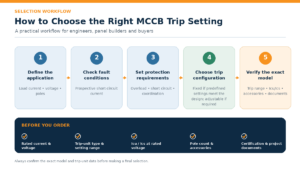
Consider an illustrative factory distribution system with a main panel supplying several downstream feeders. Some feeders serve stable, standardized loads, while others require more detailed protection coordination with downstream devices.
For each feeder, the engineer should first establish the design current, conductor characteristics, available short-circuit current and required protection behavior.
For a feeder with well-defined requirements, a fixed-trip MCCB may be suitable if its trip characteristics satisfy the protection design. A more flexible trip-unit configuration may be worth considering for a feeder that requires specific adjustable settings to support the coordination study.
The engineer should then verify the selected MCCB’s rated voltage, breaking capacity, trip characteristics and coordination with adjacent devices. If adjustable settings are used, the final values should be documented and checked against the design.
The example illustrates an important principle: different feeders within the same distribution panel may require different protection configurations. There is no need to choose one trip-setting approach for every circuit simply to keep the panel uniform.
This is an illustrative engineering scenario, not a report of a specific SSPD customer installation.
MCCB Buyer Checklist: What Should You Confirm Before Ordering?
For distributors, switchgear manufacturers and project buyers, the distinction between fixed and adjustable trip settings should be part of a broader technical review.
Before placing an order, confirm the following information with your supplier.
Electrical specifications
- Rated current and frame rating.
- Rated operational voltage.
- Number of poles.
- Ultimate and service short-circuit breaking capacities at the specified voltage.
- Required overload and short-circuit protection characteristics.
Trip-unit configuration
- Fixed or adjustable settings for the relevant protection functions.
- Available adjustment ranges and setting increments.
- Thermal-magnetic or electronic trip-unit type.
- Applicable trip curves and coordination requirements.
Product configuration
- Front or rear connection requirements, where available.
- Auxiliary contacts, shunt release or undervoltage release requirements.
- Terminal extensions, shields and other accessories.
- Applicable certificates and technical documentation.
Commercial requirements
- Required quantity and delivery schedule.
- Packaging and labeling requirements.
- OEM or customized product requirements, where applicable.
- Warranty and after-sales support.
For an accurate quotation, provide the required current rating, operating voltage, breaking capacity, trip-unit configuration and accessory list. If a project specification is available, sending it to the supplier can help reduce unnecessary model substitutions and repeated technical clarification.
Frequently Asked Questions
Is an adjustable MCCB always better than a fixed-trip MCCB?
No. An adjustable MCCB provides additional setting flexibility, but that flexibility is useful only when the application requires it. A fixed-trip MCCB can be an appropriate and economical choice when its protection characteristics satisfy the electrical design.
Can a thermal-magnetic MCCB have adjustable trip settings?
Yes. Some thermal-magnetic MCCBs provide adjustment for certain protection parameters, such as magnetic pickup. The available adjustment depends on the product design. Thermal-magnetic protection does not automatically mean that all trip settings are fixed.
Does an adjustable MCCB always use an electronic trip unit?
No. Adjustable settings can be provided by certain thermal-magnetic designs as well as electronic trip units. Electronic configurations may offer a broader set of adjustment and protection functions, but the exact features must be confirmed in the product documentation.
Does an adjustable MCCB have a higher breaking capacity?
Not necessarily. Breaking capacity and trip-setting flexibility are separate characteristics. A breaker must meet the required short-circuit breaking capacity at the specified operating voltage regardless of whether its trip settings are fixed or adjustable.
Can MCCB trip settings be changed after installation?
Only when the selected model supports adjustment, and only within its specified limits. Changes should be made by qualified personnel according to the protection design and manufacturer instructions, followed by appropriate verification and documentation.
How should I choose between SSPD CEZC and CNSX?
Start with the required rated current, operating voltage, breaking capacity, trip characteristics and accessories. Then compare the exact CEZC and CNSX model configurations against those requirements. If the project requires adjustable settings, confirm which model and trip unit provide the necessary functions and adjustment ranges.
Conclusion: Choose the Trip Configuration That Fits Your Application
Fixed-trip and adjustable-trip MCCBs serve different protection requirements. Fixed settings can simplify selection for standardized circuits, while adjustable settings provide additional flexibility when a project requires tailored protection or coordination.
For SSPD CEZC and CNSX MCCBs, the correct decision should be based on the exact model, trip-unit configuration and verified electrical requirements—not simply the series name or rated current.
If you are sourcing MCCBs for distribution panels, industrial projects or wholesale supply, share your required current rating, operating voltage, breaking capacity and protection settings with SSPD. Our team can help you identify a suitable configuration and confirm the relevant technical specifications.
About the Author
Jimmy Zheng
International Business Manager at SSPD
Jimmy Zheng has more than 10 years of experience in low-voltage electrical products and international B2B business. He works with electrical distributors, switchgear manufacturers and industrial buyers to help identify suitable circuit protection solutions.
His focus includes MCCB, ACB, MCB, motor protection circuit breakers and AC contactors, with particular attention to product selection, technical communication and international sourcing.
Technical Review
SSPD Engineering Team
Technical content and product references should be reviewed against the applicable SSPD product specifications and relevant electrical standards before publication.