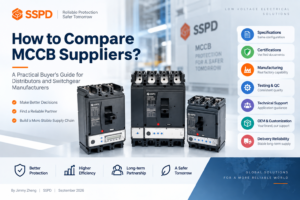
How Should I Compare MCCB Suppliers? A Practical Evaluation Guide
By Jimmy Zheng · SSPD · Updated September 2026
Quick Answer
To compare MCCB suppliers properly, first make sure they are quoting the same technical specification. Then evaluate compliance, Icu and Ics, trip unit, testing evidence, manufacturing capability, batch consistency, technical support, OEM capability, delivery reliability and after-sales support. Unit price should only be compared after the technical configuration has been normalized.
For distributors, switchgear manufacturers and project buyers, choosing an MCCB supplier is rarely just a matter of finding the lowest quotation.
Two breakers may both be marked 250A, yet differ substantially in breaking capacity, trip unit, certification scope, accessories, testing and long-term consistency.
A useful supplier comparison therefore starts with one question:
Are we actually comparing the same product?
1. Start by Standardizing the MCCB Specification
Before sending an RFQ to several suppliers, prepare one standardized specification.
For example:
| Parameter | Example Requirement |
|---|---|
| Rated current | 250A |
| Poles | 3P |
| Rated operational voltage | 415V AC |
| Breaking capacity | Icu ≥ 36kA |
| Trip unit | Thermal-magnetic |
| Installation | Fixed |
| Standard | IEC 60947-2 |
| Accessories | Auxiliary contact + shunt trip |
| Quantity | 100 pcs |
This simple step prevents one of the most common sourcing mistakes: comparing quotations that look similar but are technically different.
A 250A MCCB with 25kA breaking capacity should not automatically be compared directly with a 250A MCCB rated at 36kA or 50kA.
The same applies to:
- Ics
- Trip unit type
- Accessories
- Voltage rating
- Certification
- Installation method
If you are still defining the basic breaker configuration, start with our guide on how to select the right MCCB for industrial applications.
2. Compare the Technical Specification Before the Price
Once the RFQ has been standardized, compare the actual breaker specifications line by line.
Important parameters include:
- Rated current (In)
- Frame size
- Number of poles
- Rated operational voltage (Ue)
- Rated insulation voltage (Ui)
- Rated impulse withstand voltage (Uimp)
- Ultimate breaking capacity (Icu)
- Service breaking capacity (Ics)
- Trip unit type
- Adjustable protection settings
- Mechanical and electrical endurance
- Available accessories
- Installation type
For example, one supplier may quote:
250A, 3P, 25kA, fixed thermal-magnetic trip
while another offers:
250A, 3P, 36kA, adjustable thermal-magnetic trip with auxiliary contact.
The second quotation may be more expensive, but it is not necessarily a more expensive version of the same product. It may simply be a different technical configuration.
If you are unsure how to determine the correct current rating, see what size MCCB you need and how to calculate the correct MCCB rating.
Breaking capacity should also be compared carefully. Our guide on how to choose MCCB breaking capacity explains when 18kA, 25kA, 36kA, 50kA or higher ratings may be appropriate.
If the quotations show different Icu and Ics values, refer to Icu vs Ics in MCCBs before comparing prices.
3. Verify Compliance — Do Not Just Ask for “CE”
Certification is important, but buyers should look beyond the logo printed on a catalog or breaker label.
For IEC-market circuit breakers, the supplier should be able to provide documentation that matches the quoted product series and rating.
When reviewing documentation, check whether it corresponds to:
- The manufacturer
- Product series
- Frame size
- Rated voltage
- Current range
- Breaking capacity
- Applicable standard
A certificate belonging to one product family does not automatically prove that every MCCB offered by that supplier has the same certification scope.
Useful questions to ask
- Can you provide the certificate?
- Can you provide the corresponding test report?
- Does this document cover the exact model quoted?
- Which frame sizes are included?
- Which Icu ratings are covered?
- Is the certificate currently valid?
For serious projects, document verification is more useful than simply asking:
“Do you have CE?”
4. Evaluate the Factory Behind the Product
A supplier’s website can look professional even when its actual manufacturing capability is limited.
For long-term MCCB sourcing, buyers should understand what is really happening behind the quotation.
Questions worth asking include:
- Are you the manufacturer or a trading company?
- Which MCCB processes are completed in-house?
- How many production lines are operating?
- What is normal monthly capacity?
- What testing equipment is available?
- Can you show the production line by video?
- Can customers visit the factory?
- How are incoming components inspected?
- How are finished products released?
Factory size alone does not determine quality.
The more important question is:
Can this factory repeatedly manufacture the product you approved?
5. Compare Quality Control and Testing Evidence
Every MCCB supplier will say its quality is good.
A more useful question is:
How do you know?
Ask suppliers which inspections and tests are performed during production and before shipment.
Depending on the product and production process, relevant checks may include:
- Trip calibration
- Mechanical operation
- Insulation or dielectric testing
- Appearance inspection
- Assembly verification
- Temperature-rise testing
- Endurance testing
- Type-test documentation
- Final inspection
Do not assume every test is performed on every individual breaker. Some tests may be production inspections, while others are sampling, verification or type tests.
The supplier should be able to explain the difference.
Evidence is more useful than claims
Instead of accepting:
“Our quality is very stable.”
ask for:
- Test equipment photos
- Factory testing videos
- Inspection records
- Batch records
- Relevant test reports
For a long-term distributor, these are often more informative than a polished product brochure.
6. A Good Sample Does Not Guarantee a Good Production Batch
This is one of the most important points when evaluating a new MCCB supplier.
A sample may perform well, but the real commercial challenge is whether the factory can reproduce the same configuration over repeated production batches.
Before approving a sample, document important details such as:
- Housing material and appearance
- Trip unit
- Terminal design
- Contacts
- Label information
- Accessories
- Packaging
- Product markings
Then compare the bulk order against the approved sample.
From my experience working with international distributors and electrical buyers, long-term consistency is often more valuable than achieving the lowest price on the first order.
A supplier becomes valuable when the buyer does not need to re-qualify the product every time a repeat order is placed.
7. Test the Supplier’s Technical Support Before You Order
You can learn a lot about an MCCB supplier before placing an order.
One simple test is to send several suppliers the same incomplete request:
“We need a 250A MCCB for an industrial distribution panel.”
Then compare their responses.
A technically capable supplier may ask:
- What is the system voltage?
- 3P or 4P?
- What breaking capacity is required?
- Thermal-magnetic or electronic trip?
- Fixed, plug-in or withdrawable installation?
- Are auxiliary contacts required?
- Is a shunt trip or undervoltage release needed?
- Which certification is required?
A supplier that immediately provides only a price may still be able to supply the product, but it gives you less evidence of its application-support capability.
For project buyers and switchgear manufacturers, technical communication becomes particularly important when dealing with:
- Protection coordination
- High breaking capacity
- Electronic trip units
- Motorized mechanisms
- Rotary handles
- Auxiliary contacts
- Shunt trips
- Undervoltage releases
A good supplier should know when it needs more information before recommending a model.
8. Compare OEM Capability in Detail
Many MCCB suppliers say:
“OEM available.”
That statement alone does not tell you very much.
For distributors building their own brand, ask exactly what can be customized.
Possible items include:
- Logo
- Product label
- Rating label
- Product color
- Carton
- Inner packaging
- User manual
- Barcode
- Model number
- Accessory packaging
Also clarify:
- MOQ
- Lead time
- Artwork requirements
- Additional cost
- Whether tooling is required
- Whether the customized configuration can be repeated consistently
For a distributor, OEM is not just about putting a logo on a breaker.
It is about creating a product that can be supplied consistently under your brand for several years.
9. Compare Long-Term Supply Reliability
A surprisingly low quotation is not useful if the supplier cannot maintain delivery.
Ask about:
- Normal production lead time
- Peak-season lead time
- Repeat-order lead time
- Mixed-model orders
- Spare accessory availability
- Model continuity
- Production planning
- Replacement support
For wholesalers, this matters because customers may come back months later asking for:
- The same MCCB
- The same handle
- The same shunt trip
- The same auxiliary contact
If accessories or product dimensions change frequently, after-sales support becomes much more difficult.
10. Normalize the Specification Before Comparing Price
Consider this illustrative example:
| Item | Supplier A | Supplier B | Supplier C |
|---|---|---|---|
| Rated current | 250A | 250A | 250A |
| Poles | 3P | 3P | 3P |
| Icu | 25kA | 36kA | 36kA |
| Ics | 12.5kA | 18kA | 25kA |
| Trip unit | Fixed thermal-magnetic | Adjustable thermal-magnetic | Adjustable thermal-magnetic |
| Auxiliary contact | No | Optional | Optional |
| Test documentation | Basic | Available | Available |
| Technical support | Basic | Application support | Application + configuration support |
This is an illustrative comparison, not an assessment of specific companies. Actual specifications must be verified with each supplier.
All three suppliers may legitimately quote different prices.
But comparing only the final unit price would hide the technical differences.
A higher breaking capacity also does not automatically mean a better purchase. For a detailed explanation, see is a higher MCCB breaking capacity always better?.
This is why the correct sequence is:
Specification → Compliance → Quality → Supply Capability → Support → Price
not:
Price → Everything Else
11. Watch for Supplier Red Flags
None of the following automatically proves that a supplier is unreliable, but each one deserves additional verification.
1. Certificate and quoted model do not match
Ask for clarification before proceeding.
2. The supplier cannot explain Icu and Ics
For an MCCB supplier, basic breaking-capacity knowledge should normally be expected.
3. Product specifications change during quotation
Confirm the final configuration in writing.
4. Datasheet information conflicts with the product label
Stop and verify which specification is correct.
5. Sample and bulk-product descriptions differ
Confirm whether materials or components have changed.
6. No testing evidence is available
Ask how production quality is verified.
7. Every product is described as “in stock”
For a supplier claiming a very wide range, verify actual inventory and production capability.
8. An unusually low price cannot be technically explained
There may be a legitimate reason, but verify what specification, material, certification or service level is included.
12. Use an MCCB Supplier Comparison Checklist
A simple comparison sheet can make supplier evaluation much easier.
| Evaluation Item | Supplier A | Supplier B | SSPD |
|---|---|---|---|
| Specification Match | Basic match | Good match | Detailed configuration support |
| Icu / Ics Clarity | Sometimes incomplete | Usually clear | Clear product selection support |
| IEC Documentation | Basic / on request | Available | CE / CB / CCC / RoHS support by series |
| Manufacturer Verification | Limited visibility | Factory information available | Direct manufacturer, founded in 1992 |
| Production Capability | Small / flexible | Medium-scale | 10 production lines |
| Testing Evidence | Basic final inspection | Standard QC records | Calibration, temperature-rise and life-test capability |
| Finished Product Inspection | Sampling | Sampling / batch control | 100% finished-product inspection stated |
| Test Traceability | Limited | Available for key batches | Digital test logs stated for MCCB testing |
| Sample-to-Batch Control | Requires buyer follow-up | Generally controlled | Structured production and QC process |
| Technical Support | Mainly quotation-based | Product-selection support | Selection + configuration + accessory support |
| OEM Capability | Logo / carton | Logo + packaging | Logo, label, packaging and broader customization support |
| Accessory Support | Basic | Good | Broad MCCB accessory range |
| Customization Depth | Low | Medium | Engineering review for customized specifications |
| Standard Lead Time | Fast for simple models | Moderate | Approx. 25 days stated for regular production |
| Warranty | 12 months typical* | 12–18 months typical* | 24 months stated |
| After-Sales Support | Basic replacement | Standard support | Technical and replacement support |
| Best Fit | Very price-sensitive buyers | General industrial sourcing | Distributors, switchgear manufacturers, OEM/private-label buyers |
The purpose is not to give every supplier a numerical score.
It is to make sure the final commercial comparison is based on the same requirements.
13. Which Type of MCCB Supplier Is Right for You?
Different buyers may need different types of suppliers.
A trader purchasing standard products for occasional orders may prioritize:
- Flexible quantity
- Fast availability
- Low acquisition cost
A switchgear manufacturer may care more about:
- Stable dimensions
- Accessories
- Breaking capacity
- Trip-unit options
- Engineering support
A distributor building a long-term private brand may prioritize:
- Product consistency
- OEM capability
- Certifications
- Packaging
- Stable supply
- Product range
- Technical support
There is therefore no single supplier characteristic that is “best” for every buyer.
The objective is to find the supplier whose capability matches your business model.
For buyers still comparing breaker categories, our MCCB vs MCB guide explains the main differences in current range, breaking capacity, adjustability and typical application.
How SSPD Supports MCCB Buyers
SSPD manufactures low-voltage circuit protection products for distributors, switchgear companies and industrial customers.
Our MCCB supply capability includes multiple product platforms, different current and breaking-capacity options, accessories, OEM support and technical assistance for product configuration.
SSPD operates 10 production lines and supports customers with product selection, customization, testing information and repeat-order supply.
If you are comparing several MCCB quotations, you can send us the technical requirements or competing specifications you are evaluating.
Rather than comparing only the unit price, our team can help you check:
- Rated current
- Voltage
- Icu / Ics
- Trip unit
- Accessories
- Installation
- Certification requirements
so that the products are compared on the same technical basis.
Frequently Asked Questions
What documents should I ask an MCCB supplier to provide?
At minimum, request the product datasheet and relevant certification or test documentation. For larger projects, buyers may also request factory information, inspection records, drawings, accessory documentation and product-specific technical reports.
Should I request MCCB samples before a bulk order?
For a new supplier or private-label project, samples are useful for checking appearance, dimensions, operation, markings, accessories and general product consistency before committing to a larger purchase.
How can I verify an MCCB manufacturer?
Check the company’s factory information, production capability, product range, testing equipment, certification ownership and ability to show actual manufacturing operations. A factory visit or live video inspection can provide additional evidence.
How do I compare two MCCBs with the same rated current?
Do not compare rated current alone. Check Icu, Ics, Ue, Ui, Uimp, trip-unit type, poles, accessories, installation method, applicable standards and testing documentation.
If you are unsure whether the current rating itself is correct, see how to calculate the correct MCCB rating.
Is the cheapest MCCB supplier always the lowest-cost supplier?
Not necessarily. Purchase cost is only one part of the total sourcing cost. Inconsistent products, technical problems, replacement requirements, delayed deliveries or accessory incompatibility may create additional costs later.
What should I check during an MCCB factory audit?
Focus on incoming inspection, assembly processes, test equipment, calibration, production records, final inspection, traceability, storage, production capacity and whether the factory can consistently manufacture the approved product.
About the Author
Jimmy Zheng
International Business Manager | SSPD
Jimmy Zheng has more than 10 years of experience working with low-voltage electrical products and international B2B customers.
He works with electrical distributors, switchgear manufacturers and industrial buyers on MCCB, ACB, motor protection and contactor sourcing, with a particular focus on product selection, supplier evaluation, OEM projects and long-term supply.
Technical Review: SSPD Engineering Team
Technical content is reviewed for product specifications, application logic and relevant low-voltage circuit protection requirements.