MCCB Category A vs Category B: What Is the Difference?
Quick Answer: What Is the Difference Between Category A and Category B MCCBs?
Category A and Category B MCCBs differ mainly in their short-circuit selectivity characteristics. Category A circuit breakers are not specifically designed for time-delayed short-circuit selectivity and have no rated short-time withstand current (Icw). Category B circuit breakers are designed to support time-based selectivity through an intentional short-time delay and have a specified Icw rating.
Why Does MCCB Category Matter in Industrial Power Distribution?
When a short circuit occurs in an industrial distribution system, an incorrectly coordinated protection system may disconnect more circuits than necessary. This can interrupt production, affect connected equipment and increase recovery time. Understanding Category A and Category B helps engineers select circuit breakers according to the system’s protection and selectivity requirements.
1. What Are Category A and Category B MCCBs?
Category A and Category B are circuit-breaker selectivity categories defined in IEC 60947-2. They describe how a circuit breaker is designed to coordinate with other protective devices connected in series under short-circuit conditions.
These categories do not represent product quality grades or simply indicate which breaker has a higher breaking capacity. Instead, they relate to whether the breaker is specifically designed to provide short-circuit selectivity through an intentional short-time delay.
What Is a Category A MCCB?
A Category A circuit breaker is not specifically intended to provide short-circuit selectivity through an intentional short-time delay.
Its main characteristics include:
- No intentional short-time delay for short-circuit selectivity.
- No rated short-time withstand current (Icw).
- Fast short-circuit interruption according to its protection characteristics.
- Common use in outgoing feeders and branch distribution circuits.
Category A breakers are widely used in industrial and commercial electrical distribution systems where fast fault interruption is required.
However, Category A does not mean that selectivity is impossible. Selectivity may still be achieved through other coordination methods, such as current limitation or energy-based discrimination, depending on the characteristics of the selected breakers.
What Is a Category B MCCB?
A Category B circuit breaker is specifically intended to support short-circuit selectivity through an intentional short-time delay.
Its main characteristics include:
- Intentional short-time delay, which may be adjustable.
- A rated short-time withstand current (Icw).
- The ability to remain closed during a specified short-circuit withstand period under defined conditions.
- Suitability for time-based coordination with downstream protective devices.
Category B circuit breakers are commonly considered for main incoming protection and other positions where maintaining power to unaffected parts of a distribution system is important.
The actual performance must be verified against the manufacturer’s rated Icw, delay settings and coordination data.
2. Category A vs Category B MCCB: Key Differences
The following table summarizes their main technical differences.
| Technical Feature | Category A | Category B |
|---|---|---|
| Short-circuit selectivity | Not specifically designed for intentional time-delay selectivity | Specifically designed for time-delay selectivity |
| Intentional short-time delay | No, for short-circuit selectivity | Yes |
| Rated Icw | Not assigned | Assigned |
| Short-circuit response | Operates according to its protection characteristics without intentional short-time selectivity delay | Can delay tripping within its specified withstand conditions |
| Typical application | Outgoing feeders and branch circuits | Main incoming and coordinated distribution circuits |
| Selection priority | Appropriate fault interruption and coordination | Short-time withstand capability and time-based coordination |
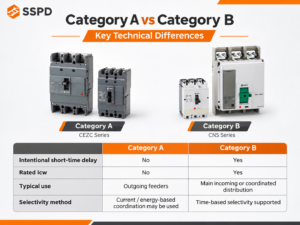
An important point is that Category B is not automatically better than Category A. The appropriate category depends on the protection requirements and distribution arrangement.
3. What Is Icw in an MCCB?
Icw stands for Rated Short-Time Withstand Current.
It is the current that a circuit breaker can carry in the closed position for a specified short period under prescribed conditions without unacceptable damage.
Icw is particularly important for Category B circuit breakers because it determines the short-circuit current level that the breaker can withstand during its intentional time delay.
Why Is Icw Important?
Consider an industrial distribution system with one main incoming breaker and several downstream feeder breakers.
If a short circuit occurs in one outgoing feeder, the downstream breaker should ideally interrupt the fault first. The upstream breaker can remain closed temporarily, allowing the unaffected feeders to continue operating.
For this coordination strategy to work, the upstream breaker must be capable of withstanding the relevant fault current during the selected delay period.
This is where Icw becomes important.
The rated short-time withstand current must be considered together with its associated duration. A current rating without its specified time condition does not provide a complete description of the withstand capability.
Icw vs Icu vs Ics
These three parameters are often confused when selecting MCCBs.
| Parameter | Full Name | Main Function |
|---|---|---|
| Icu | Ultimate Short-Circuit Breaking Capacity | Indicates the ultimate short-circuit current the breaker can interrupt under specified test conditions |
| Ics | Service Short-Circuit Breaking Capacity | Indicates the service-level short-circuit breaking capability under specified test conditions |
| Icw | Rated Short-Time Withstand Current | Indicates the short-circuit current the closed breaker can withstand for a specified short duration |
Icu and Ics describe the breaker’s ability to interrupt short-circuit current. Icw describes its ability to withstand short-circuit current while remaining closed for a specified time.
These parameters serve different purposes and should not be used interchangeably.
4. How Does Short-Time Selectivity Work?
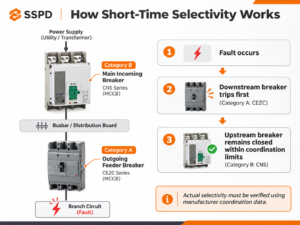
Short-time selectivity coordinates the operating times of upstream and downstream circuit breakers.
Consider a typical industrial distribution arrangement:
- An upstream breaker protects the main distribution board.
- Downstream breakers protect individual feeders.
- A short circuit occurs in one downstream branch.
With a properly coordinated Category B upstream breaker, the upstream breaker can use an intentional short-time delay while the downstream breaker attempts to clear the fault first.
The expected sequence is:
- A short circuit occurs in a downstream feeder.
- Both upstream and downstream protective devices may detect the abnormal current.
- The downstream breaker operates according to its protection characteristics.
- If the downstream breaker clears the fault within the verified coordination limits, the upstream breaker remains closed.
- The unaffected parts of the electrical system can continue operating.
This arrangement can reduce unnecessary interruptions across the distribution system.
Does Category B Guarantee Complete Selectivity?
No.
Category B supports time-based selectivity, but it does not automatically guarantee total selectivity under every fault condition.
The result depends on several factors:
- Available short-circuit current.
- Rated Icw of the upstream breaker.
- Short-time delay settings.
- Downstream breaker characteristics.
- Instantaneous trip settings.
- Manufacturer-verified selectivity data.
If the fault current exceeds the applicable coordination limit, or an instantaneous protection function operates, both breakers may trip.
Engineers should therefore verify the actual breaker combination rather than relying only on the Category B designation.
5. Where Are Category A and Category B MCCBs Used?
Both categories have important roles in low-voltage electrical distribution.
Category A Applications
Category A MCCBs are commonly used in:
- Industrial outgoing feeders.
- Commercial distribution panels.
- Branch circuit protection.
- General power distribution systems.
- Equipment protection circuits.
They are suitable where fast fault interruption is required and the system does not rely on intentional short-time delay for short-circuit selectivity.
Category B Applications
Category B circuit breakers are commonly considered for:
- Main incoming protection.
- Large industrial distribution systems.
- Main switchboards.
- Systems requiring time-based coordination.
- Applications where continuity of unaffected circuits is important.
For these applications, the engineer should evaluate the required short-time withstand current, delay settings and coordination with downstream protective devices.
The installation position alone does not determine the category. The actual electrical design and protection requirements are decisive.
6. Is Category B Always Better Than Category A?
No. Category B is not automatically better than Category A.
The two categories are designed for different protection and coordination requirements.
Category A may be a suitable choice when:
- Fast short-circuit interruption is required.
- The circuit is used for outgoing feeder protection.
- The system does not require intentional short-time delay.
- Appropriate selectivity can be achieved through other verified coordination methods.
Category B may be more appropriate when:
- Time-based selectivity is required.
- The upstream breaker needs an intentional short-time delay.
- The breaker has a specified Icw rating.
- The electrical system requires coordinated protection between multiple distribution levels.
Selecting Category B without an actual need for short-time selectivity may add unnecessary complexity or cost.
The correct decision should always be based on the electrical system design, not simply on choosing the higher category.
7. How to Select the Right MCCB Category?
Before choosing an MCCB, engineers should review the complete distribution system.
The following steps provide a practical starting point.
Step 1: Identify the Breaker’s Position
Determine whether the breaker will be installed as:
- A main incoming breaker.
- An intermediate distribution breaker.
- An outgoing feeder breaker.
This helps establish the required protection and coordination functions.
Step 2: Determine the Prospective Short-Circuit Current
Calculate or obtain the prospective short-circuit current at the installation point.
The selected circuit breaker must have sufficient interrupting capacity for the actual system conditions.
Step 3: Define the Selectivity Requirement
Determine whether the project requires the downstream breaker to interrupt a fault without operating the upstream breaker.
If time-based short-circuit selectivity is required, a Category B solution may need to be considered.
Step 4: Check Icw and Short-Time Delay
For a Category B breaker, confirm:
- Rated Icw.
- Associated withstand duration.
- Available short-time delay settings.
- Applicable protection configurations.
Do not assume that an electronic trip unit or a short-time protection function automatically qualifies a breaker as Category B.
Step 5: Verify the Coordination Results
Review the manufacturer’s time-current curves and selectivity tables for the actual upstream and downstream breaker combination.
The final selection should be based on verified coordination performance and the project’s applicable electrical standards.
8. SSPD MCCB Product Capabilities
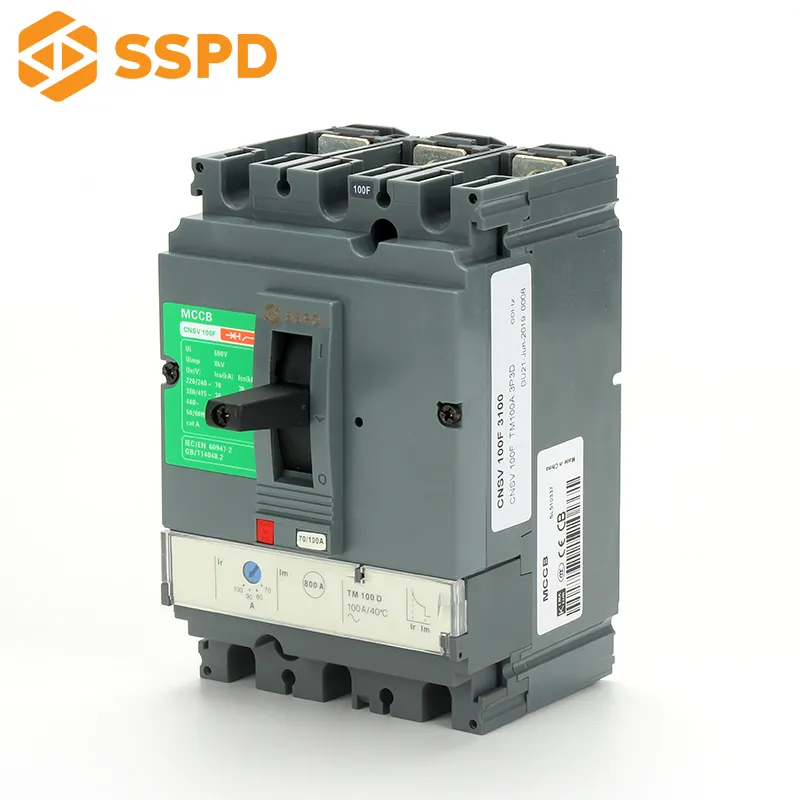
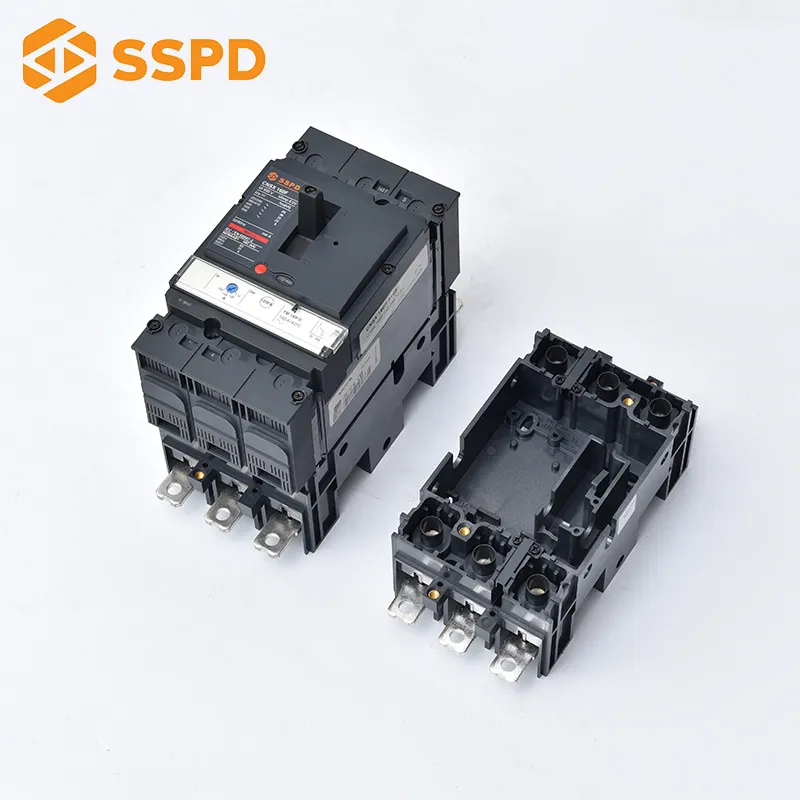
SSPD manufactures a range of AC molded case circuit breakers for low-voltage power distribution applications.
Different product families are designed to address different current ratings, protection requirements and installation conditions.
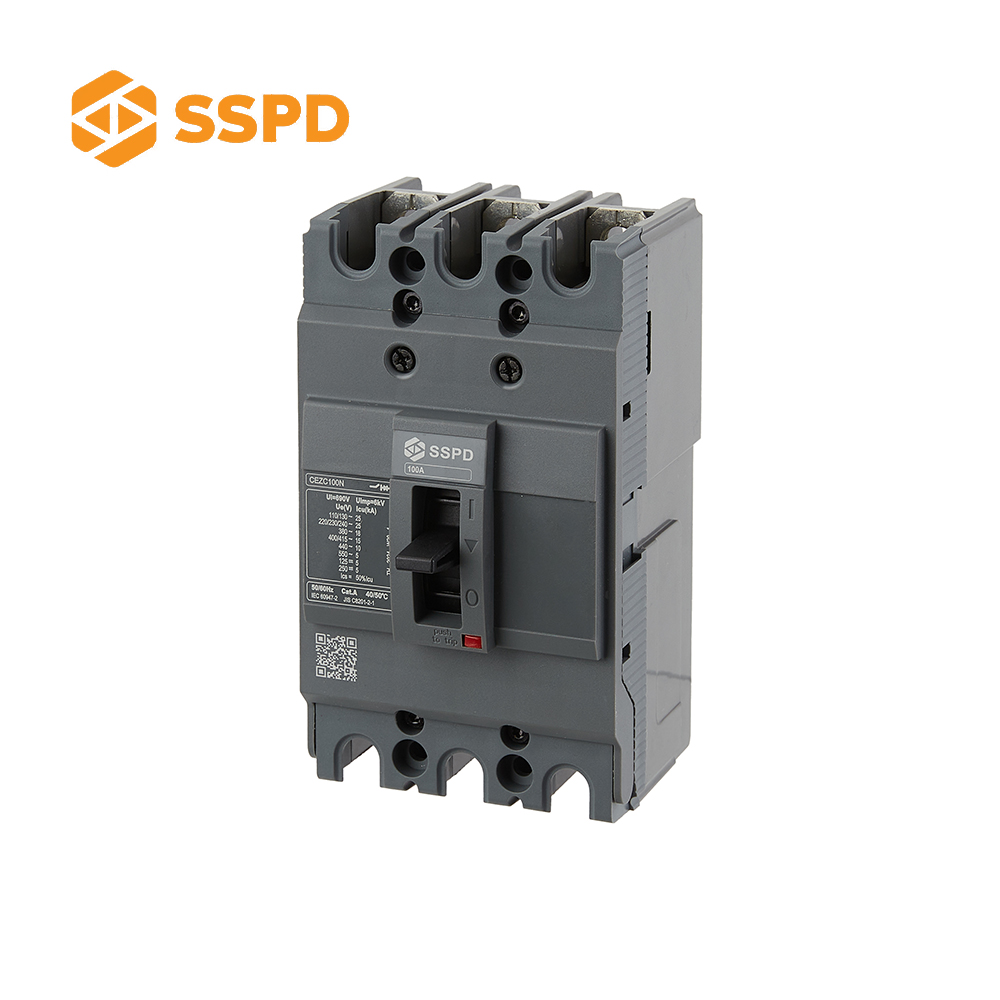
CEZC Series: Category A MCCB
The SSPD CEZC series covers rated currents from 15A to 630A and is specified as Category A in its published product information.
Depending on the frame size and configuration, the series offers thermal-magnetic and electronic protection options.
It is suitable for general low-voltage distribution and equipment protection applications.
CNS Series: Electronic Protection Functions
The SSPD CNS 800–1600A series is designed for higher-current distribution applications.
Its published technical information includes:
- Long-time protection: Ir.
- Short-time protection: Isd.
- Instantaneous protection: Ii.
- Electronic protection characteristics.
SSPD also lists long-time, short-time and instantaneous protection testing equipment in its manufacturing process.
These capabilities provide useful protection-setting options for industrial distribution applications.
However, the presence of a short-time protection function alone does not establish a Category B classification. The corresponding Icw rating, withstand duration and applicable test documentation must also be verified before making that declaration.
For detailed specifications, refer to the SSPD CEZC MCCB series and SSPD CNS MCCB series.
Frequently Asked Questions
1. What Is the Main Difference Between Category A and Category B MCCBs?
The main difference is their short-circuit selectivity design. Category A breakers are not specifically designed for intentional short-time delay under short-circuit conditions and have no rated Icw. Category B breakers have an intentional short-time delay and a rated short-time withstand current.
2. Does Category A MCCB Have an Icw Rating?
Category A circuit breakers do not have a rated Icw under the Category A classification. They may still achieve selectivity through other coordination methods, depending on the specific breaker characteristics and manufacturer’s verified data.
3. Can an MCCB Be Category B?
Yes. Some heavy-duty molded case circuit breakers can be designed as Category B. However, they must meet the applicable short-time withstand current and short-time delay requirements. The classification should be verified through the manufacturer’s technical documentation.
4. Is an Electronic MCCB Automatically Category B?
No. An electronic trip unit may provide adjustable protection functions, including short-time protection. However, the presence of these functions alone does not establish Category B. The breaker must also have the required rated Icw and comply with the applicable standard requirements.
5. What Does Icw Mean in a Circuit Breaker?
Icw means Rated Short-Time Withstand Current. It indicates the current that a closed circuit breaker can withstand for a specified short duration under prescribed conditions. It is particularly relevant to Category B circuit breakers.
6. Can Category A MCCBs Achieve Selectivity?
Yes. Category A breakers may achieve selectivity through current-based or energy-based coordination methods. The actual selectivity limit must be checked using the manufacturer’s verified coordination data.
7. Is Category B Better for Main Distribution Panels?
Category B can be appropriate for main distribution applications where intentional short-time delay and time-based selectivity are required. However, the final choice depends on the system’s fault level, protection settings and coordination requirements.
8. Can I Select an MCCB Based Only on Its Category?
No. Category is only one selection factor. Rated current, voltage, Icu, Ics, installation conditions and coordination requirements must also be evaluated.
Conclusion
Category A and Category B MCCBs serve different protection and selectivity requirements. Category A is suitable for many general distribution applications, while Category B supports time-based short-circuit coordination through an intentional delay and a rated Icw. The correct choice depends on the electrical system design and verified protection performance.
If you are selecting MCCBs for an industrial distribution project, SSPD can help review your current rating, voltage, short-circuit requirements and protection configuration.
About SSPD
SSPD is a manufacturer of low-voltage electrical protection products, including MCCBs, ACBs, MCBs, AC contactors and motor protection circuit breakers.
With manufacturing and engineering capabilities, SSPD supports international distributors, switchgear manufacturers and industrial customers with product selection, customized configurations and OEM/ODM services.
About the Author
Jimmy Zheng
International Business Manager at SSPD
Jimmy Zheng has more than 10 years of experience in low-voltage electrical products and international B2B business. Through working with electrical distributors, switchgear manufacturers and industrial customers, he focuses on practical product selection, circuit protection applications and international sourcing.
His articles share insights into MCCB, ACB, MCB and AC contactor applications, helping buyers better understand technical requirements and make informed sourcing decisions.
Technical Review: SSPD Engineering Team
Technical content should be reviewed against the applicable product specifications and IEC requirements before publication.