What Is Ground-Fault Protection in an MCCB and When Is It Needed?
Quick Answer
Ground-fault protection in a molded case circuit breaker (MCCB) detects specified electrical faults involving unintended current paths to earth or grounded conductive parts. Depending on the protection design, it can trigger an alarm or trip the circuit to help limit equipment damage and electrical hazards. A standard MCCB does not necessarily include dedicated ground-fault or earth-leakage protection. An appropriate trip unit, protection module, or separate protective device may be required.
Why Is Ground-Fault Protection Important?
Not every electrical fault produces enough current to activate conventional overcurrent protection promptly. When insulation fails and current flows through an unintended path to earth or grounded metalwork, the resulting hazard depends on the grounding arrangement, fault impedance, and protective devices installed.
Without suitable protection, some faults may remain undetected or persist longer than intended, increasing the risk of equipment damage, fire, or electric shock.
For electrical engineers, switchgear manufacturers, and project buyers, understanding ground-fault protection is essential when selecting an MCCB for industrial distribution systems. The key is to identify the protection required by the installation rather than assume that every circuit breaker provides the same functions.
1. What Is Ground-Fault Protection in an MCCB?
Ground-fault protection is a protective function designed to detect specified electrical faults involving an unintended current path to earth or grounded conductive parts and initiate an appropriate response, such as circuit interruption or an alarm.
A conventional MCCB generally provides overload and short-circuit protection. Depending on its design, it may use a thermal-magnetic trip mechanism or an electronic trip unit.
However, these functions do not automatically mean that the breaker provides dedicated ground-fault protection.
A low-current ground fault may not produce enough current to activate conventional overcurrent protection promptly. In other cases, a low-impedance ground fault can produce a large current that activates the breaker’s short-circuit protection.
Whether additional protection is needed depends on the electrical system, the expected fault conditions, the required protection objective, and applicable installation standards.
What Can Ground-Fault Protection Help Prevent?
Depending on the protective device and installation, ground-fault protection can help:
- Detect specified ground-fault conditions that conventional overcurrent protection alone may not address adequately.
- Reduce the duration of certain electrical faults.
- Limit damage to electrical equipment and distribution systems.
- Support compliance with applicable electrical installation requirements.
Ground-fault protection is not a universal solution for every insulation failure or electric-shock hazard. It must be considered alongside protective earthing, insulation design, and other required safety measures.
2. How Does Ground-Fault Protection Work?
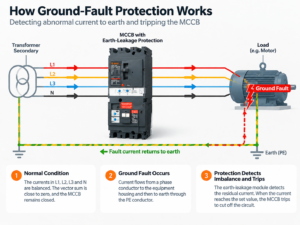
Ground-fault protection works by detecting an electrical condition associated with a fault to earth or grounded conductive parts. The detection method depends on the design of the protection device.
Residual-Current Detection
One common method is to monitor the currents flowing through the live conductors and detect an imbalance.
Under normal operating conditions, the vector sum of the currents passing through the sensing arrangement is approximately zero. If some current returns through an unintended path outside the monitored conductors, a residual current can be detected.
When the residual current reaches the configured threshold and satisfies the device’s operating conditions, the protection system can initiate an alarm or trip the circuit.
The actual response depends on the device design, sensitivity, time characteristics, and installation conditions.
Electronic Ground-Fault Protection
Some electronic trip units provide a dedicated ground-fault protection function. Depending on the design, this function may use current sensing and calculation methods to detect specified ground-fault conditions.
Not every electronic trip unit includes this capability. Its availability, settings, and compatibility with different grounding arrangements must be verified against the manufacturer’s documentation.
An important distinction: Residual-current earth-leakage protection and electronic ground-fault protection are not interchangeable in every application. Their terminology and technical scope can vary by manufacturer and regional standards.
For example, Schneider Electric’s ComPacT NSX technical documentation describes ground-fault protection and earth-leakage protection as distinct functions in specific configurations.
This is a useful industry reference for understanding the concepts, but the actual capabilities of any SSPD product must be verified using its own technical documentation.
3. Ground-Fault Protection vs. Earth-Leakage Protection
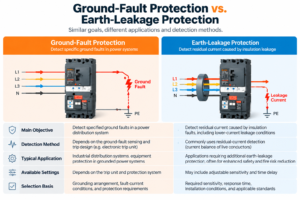
Ground-fault protection and earth-leakage protection are closely related, but they should not automatically be treated as identical.
In some industrial distribution systems, ground-fault protection refers to detecting specified faults using a dedicated ground-fault function, particularly for equipment protection in grounded power systems.
Earth-leakage protection commonly refers to detecting residual current associated with insulation faults, including certain lower-current leakage conditions.
The exact distinction depends on the manufacturer’s terminology, device design, and applicable standards.
| Consideration | Ground-Fault Protection | Earth-Leakage Protection |
|---|---|---|
| Typical objective | Detect specified ground faults in a power distribution system | Detect residual current associated with insulation faults |
| Detection method | Depends on the ground-fault sensing and trip design | Commonly uses residual-current detection |
| Typical application | Certain industrial distribution and equipment-protection systems | Applications requiring additional earth-leakage protection |
| Available settings | Depends on the trip unit and protection system | May include adjustable sensitivity and time delay |
| Selection basis | Grounding arrangement, fault-current conditions, and protection requirements | Required sensitivity, response time, installation conditions, and applicable standards |
Neither function should be selected by name alone. Engineers must verify the actual operating characteristics and suitability of the protective device for the intended application.
4. When Is Ground-Fault Protection Needed?
Ground-fault protection should be considered when the installation’s risk assessment, electrical design, or applicable standards require protection against specific ground-fault conditions.
Industrial Distribution Systems
Industrial facilities often contain large distribution boards, transformers, motors, and extensive cable networks. A ground fault can interrupt production, damage equipment, and create electrical hazards if it is not cleared appropriately.
The need for dedicated ground-fault protection depends on the system’s fault-current characteristics, existing protective devices, and design requirements.
Main Distribution Boards
Main distribution circuits may require ground-fault protection under applicable regulations or project specifications.
For example, certain US National Electrical Code requirements address ground-fault protection of equipment for qualifying service equipment and other specified installations. The applicable requirements depend on the system rating, installation details, and code edition.
Requirements in the United States should not automatically be applied to installations in Saudi Arabia, Egypt, Europe, or other markets. Buyers and engineers must check the standards applicable to the actual project.
Equipment with Insulation-Failure Risks
Insulation can deteriorate because of heat, moisture, contamination, vibration, mechanical damage, or aging.
Where an insulation fault could create unacceptable risks, engineers should assess whether conventional overcurrent protection is sufficient or whether additional ground-fault or earth-leakage protection is necessary.
Commercial and Infrastructure Projects
Commercial buildings, industrial facilities, and infrastructure projects can have different protection requirements for different circuits.
The correct solution depends on the intended protection objective. Equipment ground-fault protection, residual-current protection for specific circuits, and protection against electric shock are related but distinct design considerations.
A qualified electrical designer should determine the appropriate protective arrangement.
5. How to Select an MCCB with Ground-Fault Protection
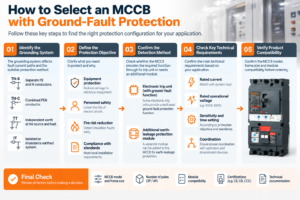
Selecting the correct configuration requires more than choosing a breaker with a suitable ampere rating.
Step 1: Identify the Grounding System
Determine whether the installation uses a TN-S, TN-C, TT, IT, or another grounding arrangement.
The grounding system affects fault-current paths and the suitability of different protection methods.
Do not select a protection module without confirming the system configuration.
Step 2: Define the Protection Objective
Clarify what the project needs to protect against.
Is the requirement to detect ground faults in a main distribution circuit, detect residual current associated with insulation failure, reduce fire risk, or provide protection required by a particular installation standard?
The answer influences the appropriate device and settings.
Step 3: Verify the Detection Method
Check whether the selected MCCB provides the required function through its trip unit or requires an additional protection module or relay.
A thermal-magnetic MCCB should not be assumed to have dedicated ground-fault protection simply because it provides overload and short-circuit protection.
Step 4: Confirm Current and Time Settings
Where the protection device provides adjustable sensitivity or time delay, the settings must match the intended protection objective and installation requirements.
Engineers should also consider coordination with upstream and downstream protective devices to avoid unnecessary interruptions while maintaining the required level of protection.
Settings should never be copied from another project without confirming that the system conditions and applicable standards are comparable.
Step 5: Check Product Compatibility
Before ordering, verify:
- MCCB model and frame size.
- Number of poles.
- Trip-unit type.
- Compatibility with the additional protection module.
- Rated operational voltage and other applicable electrical characteristics.
- Required protection settings and documentation.
- Applicable certifications and installation requirements.
A compatible-looking module is not sufficient evidence of electrical compatibility.
6. SSPD CNSX MCCB with an Earth-Leakage Protection Module
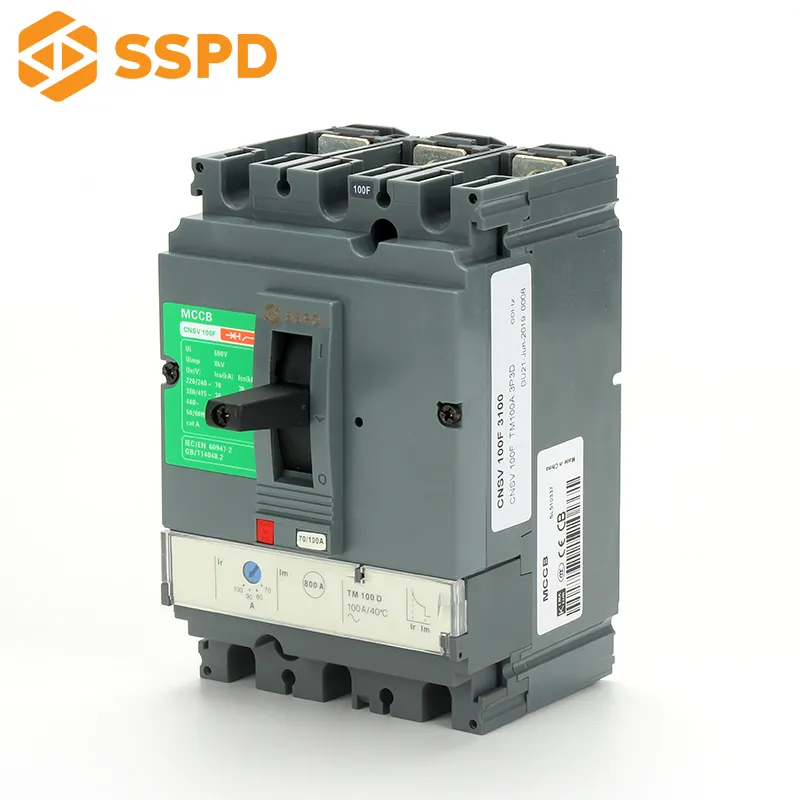
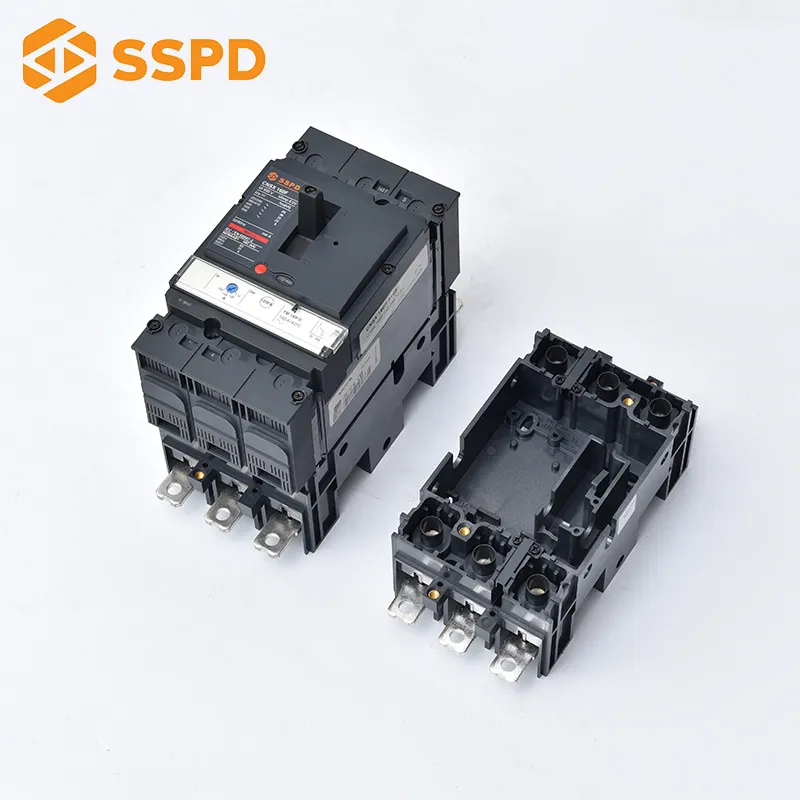
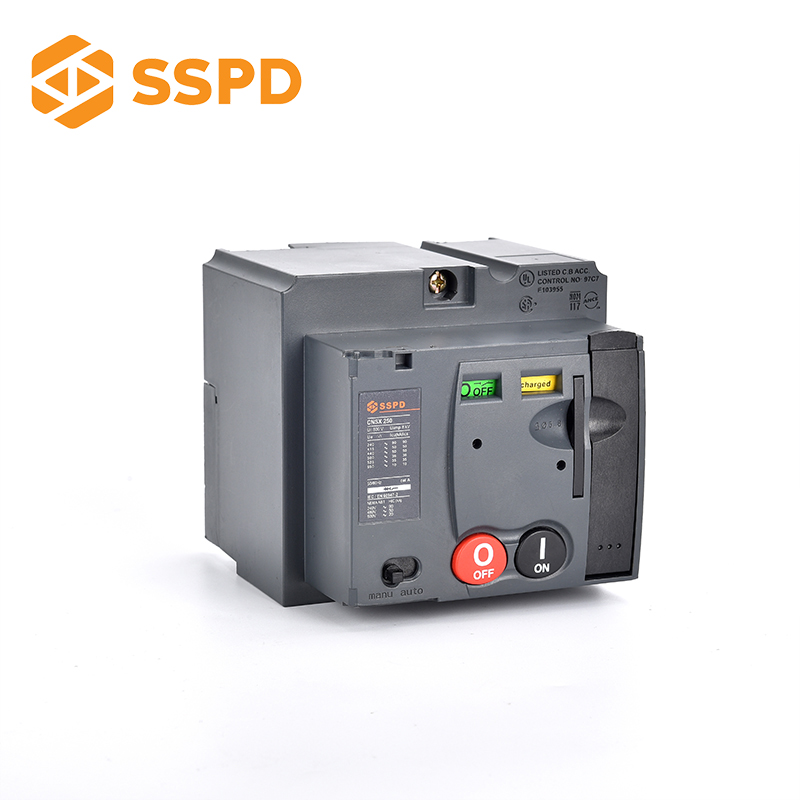
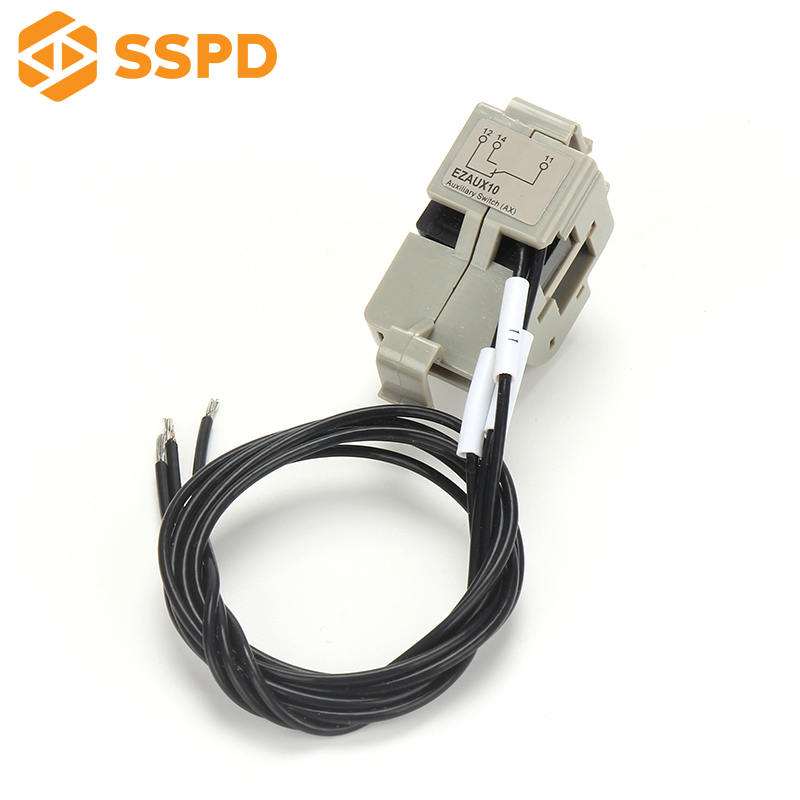
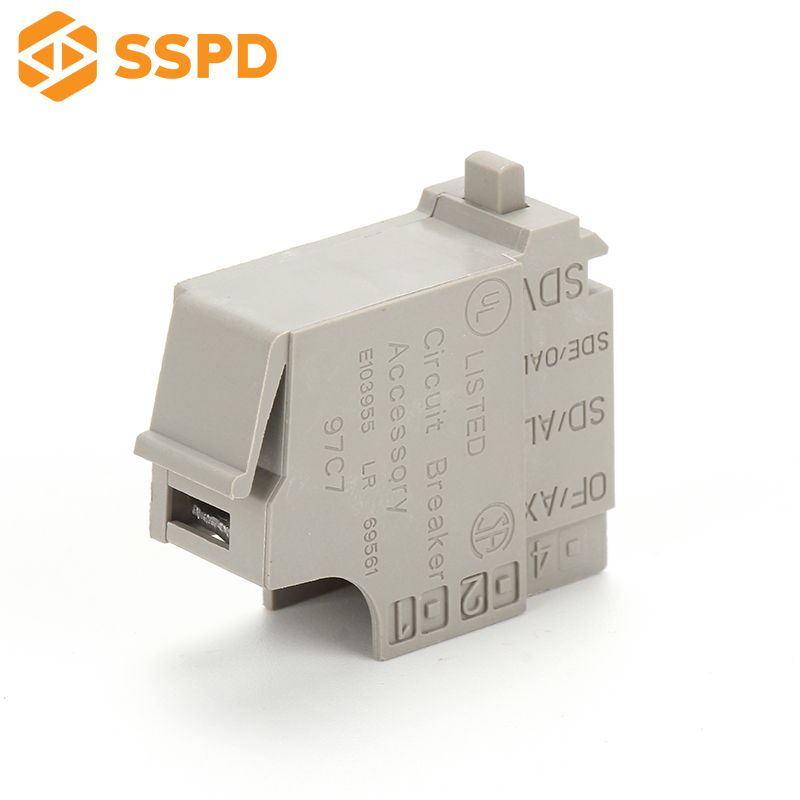
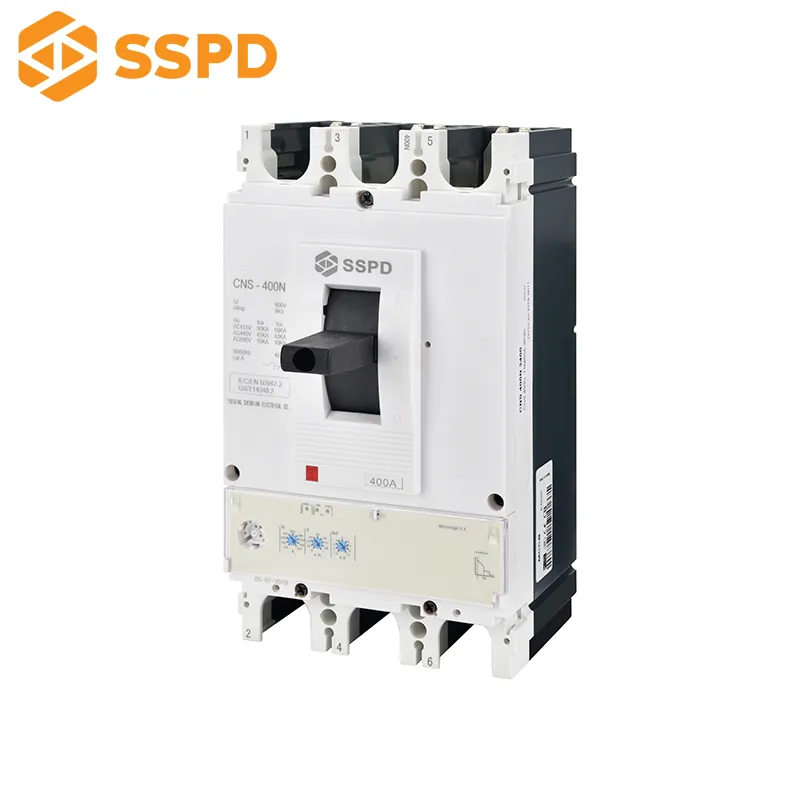
SSPD’s CNSX molded case circuit breaker is available in configurations featuring an additional earth-leakage protection module, as shown in the product images below.
This configuration is relevant to buyers who need to evaluate an MCCB together with additional earth-leakage protection rather than considering the breaker body alone.
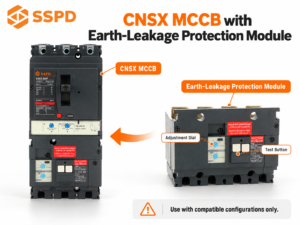
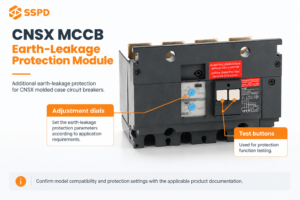
When evaluating this type of configuration, buyers should confirm the exact breaker model, module compatibility, rated voltage, protection settings, and applicable technical documentation.
Specific sensitivity ranges, trip times, and compatible configurations must be confirmed from the corresponding SSPD product documentation rather than inferred from another manufacturer’s specifications.
For distributors, switchgear manufacturers, and project buyers, verifying these details before ordering helps reduce configuration errors and supports more reliable project planning.
Explore the SSPD MCCB product range or contact the SSPD team to discuss your application requirements.
7. Common Ground-Fault Protection Selection Mistakes
Mistake 1: Assuming Every MCCB Has Ground-Fault Protection
A conventional MCCB may provide overload and short-circuit protection without a dedicated ground-fault or earth-leakage function. Always verify the exact configuration.
Mistake 2: Treating Ground-Fault and Earth-Leakage Protection as Identical in Every Application
Terminology, detection methods, and protection objectives vary. Check the relevant product documentation and installation standards.
Mistake 3: Selecting a Module Without Checking Compatibility
The module must be designed for the specific breaker configuration. Similar appearance does not guarantee compatibility.
Mistake 4: Choosing Settings Without Considering the Complete System
Sensitivity, response time, grounding arrangements, and coordination with other protective devices must be evaluated together.
Frequently Asked Questions
What is ground-fault protection in an MCCB?
It is a protective function designed to detect specified electrical faults involving an unintended current path to earth or grounded conductive parts and initiate an appropriate response, such as tripping or an alarm.
Does a standard MCCB detect ground faults?
Not necessarily. A standard MCCB generally provides overload and short-circuit protection. Whether it can detect a particular ground fault depends on the fault current and the breaker’s protection design. Dedicated protection may be required.
What is the difference between ground-fault and earth-leakage protection?
The terms can overlap, depending on the manufacturer and regional terminology. In some systems, ground-fault protection addresses specified equipment ground faults, while earth-leakage protection commonly detects residual current associated with insulation faults. The exact distinction should be checked against the relevant documentation.
Can an electronic MCCB provide ground-fault protection?
Some electronic trip units provide a dedicated ground-fault function, but not all do. Buyers should verify the specific trip-unit model, sensing method, settings, and compatibility with the electrical system.
Does an MCCB need an additional earth-leakage module?
It depends on the MCCB’s existing functions and the installation requirements. If the breaker does not provide the required earth-leakage protection, a compatible module or separate protection arrangement may be needed.
How do I choose the correct ground-fault protection settings?
Settings should be determined from the grounding arrangement, protection objective, installation conditions, applicable standards, and coordination requirements. A qualified electrical professional should verify the final settings.
Is ground-fault protection a replacement for earthing?
No. Ground-fault protection does not replace protective earthing or other required safety measures. Electrical installations need a properly designed earthing system and coordinated protective devices.
How can I select an MCCB with earth-leakage protection for an industrial project?
Start with the system voltage, rated current, grounding arrangement, protection objective, and required response characteristics. Then verify the MCCB and module compatibility, product documentation, and applicable standards before ordering.
Conclusion
Ground-fault and earth-leakage protection can play important roles in electrical safety and equipment protection, but the correct solution depends on the installation and the required protection function. Engineers and buyers should verify the grounding system, detection method, settings, coordination, and product compatibility before selecting an MCCB configuration.
If you are evaluating an SSPD CNSX MCCB with an earth-leakage protection module, share your application, system voltage, required current rating, and protection requirements with our team so we can help identify the appropriate configuration.
About the Author
Jimmy Zheng
International Business Manager at SSPD
Jimmy Zheng has more than 10 years of experience in low-voltage electrical products and international B2B business. His work focuses on helping distributors, switchgear manufacturers, and project buyers evaluate circuit protection solutions, product configurations, and sourcing requirements.
His articles cover MCCB, ACB, MCB, AC contactors, motor protection, and practical considerations for international electrical procurement.
Technical review: SSPD Engineering Team — publish this statement only after the engineering team has reviewed and approved the technical content and product claims.