Selectivity vs Cascading: What Is the Difference in Circuit Breaker Protection?
By Jimmy Zheng | International Business Manager at SSPD
Quick Answer: What Is the Difference Between Selectivity and Cascading?
Selectivity ensures that the circuit breaker closest to a fault trips first, isolating the affected circuit while keeping upstream breakers operating. Cascading uses the current-limiting capability of an upstream circuit breaker to improve the short-circuit protection capability of downstream breakers. Both techniques improve low-voltage distribution system protection, but they serve different primary purposes.
Why Does Circuit Breaker Coordination Matter?
In industrial electrical systems, a short circuit in one branch should not necessarily interrupt power to the entire distribution network. However, an incorrectly coordinated circuit breaker system may cause unnecessary upstream tripping or inadequate short-circuit protection. Understanding selectivity and cascading helps engineers design safer, more reliable power distribution systems while balancing operational continuity and equipment costs.
1. What Is Selectivity in Circuit Breaker Protection?
Selectivity, also known as discrimination, is the coordination of two or more overcurrent protective devices so that the circuit breaker closest to the fault operates first, without unnecessarily tripping upstream protective devices.
In a typical industrial distribution system, multiple MCCBs are installed in series. The upstream MCCB protects the main distribution circuit, while downstream MCCBs protect individual feeders or equipment.
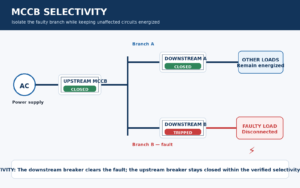
How Does Selectivity Work Between Two MCCBs?
Consider a simple electrical distribution arrangement:
- Upstream MCCB: Protects the main distribution circuit.
- Downstream MCCB: Protects a branch circuit.
- Electrical load: Connected to the downstream circuit.
When a short circuit occurs in the downstream branch, the downstream MCCB should detect the abnormal current and interrupt the faulty circuit.
If the protection characteristics are properly coordinated, the upstream MCCB remains closed and continues supplying power to other branches.
The main purpose of selectivity is to limit the interruption to the smallest possible section of the electrical installation.
Total Selectivity vs Partial Selectivity
Selectivity can be divided into two main types.
Total Selectivity
Total selectivity means that the downstream circuit breaker interrupts the fault without causing the upstream circuit breaker to operate throughout the specified operating range.
This provides a higher level of power continuity and is particularly important in critical industrial installations.
Partial Selectivity
Partial selectivity means that the downstream circuit breaker operates independently only up to a specified short-circuit current level.
This limit is known as the Selectivity Limit Current (Is).
When the actual fault current exceeds Is, both upstream and downstream breakers may operate, and selectivity can no longer be guaranteed.
For example, if a manufacturer specifies a selectivity limit of 15kA for a particular MCCB combination, the coordination is only guaranteed up to that specified limit under the stated conditions.
Engineers must compare this value with the prospective short-circuit current at the downstream installation point.
2. What Is Cascading in MCCB Protection?
Cascading, also known as backup protection or combined short-circuit protection, is a technique that uses the current-limiting capability of an upstream circuit breaker to improve the short-circuit protection performance of downstream breakers.
Unlike selectivity, which primarily focuses on which breaker operates, cascading focuses on reducing the electrical stress caused by short-circuit currents.
How Does Cascading Work?
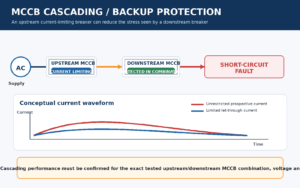
When a short circuit occurs, a current-limiting upstream MCCB can reduce the peak current and energy passing through the downstream circuit.
This helps protect downstream equipment and may allow a downstream MCCB with a lower standalone breaking capacity to be used, provided that the complete combination has been verified.
For example, a downstream MCCB may have a standalone breaking capacity lower than the prospective short-circuit current at its installation point.
However, when paired with a suitable upstream current-limiting MCCB, the tested combination may provide the required short-circuit protection.
This is the fundamental principle of cascading.
The Role of Current Limitation
To understand cascading, engineers should be familiar with three important electrical parameters.
1. Prospective Short-Circuit Current
This is the current that would flow at a particular installation point if no protective device limited the fault current.
It is an important reference when determining the required breaking capacity of a circuit breaker.
2. Peak Let-Through Current (Ip)
This represents the peak current that actually passes through a current-limiting circuit breaker during a short circuit.
By reducing the peak current, the upstream MCCB helps reduce the electrodynamic stress on downstream equipment.
3. Let-Through Energy (I²t)
I²t represents the thermal energy associated with current flowing during a fault.
Reducing let-through energy helps limit thermal stress on cables, busbars and other electrical components.
Together, peak current limitation and energy limitation explain how an upstream MCCB can improve the short-circuit protection capability of a downstream breaker combination.
What Is Backup Protection?
Backup protection is another term associated with cascading.
It allows a downstream circuit breaker with a lower standalone breaking capacity to be used when supported by a suitable upstream protective device.
However, this does not mean that any two MCCBs can automatically provide backup protection.
The combination must be verified by the manufacturer through appropriate testing and coordination data.
3. Selectivity vs Cascading: What Are the Key Differences?
Although both techniques involve coordination between upstream and downstream circuit breakers, their primary objectives are different.
| Comparison | Selectivity | Cascading |
|---|---|---|
| Main purpose | Isolate the faulty circuit | Improve short-circuit protection |
| Main concern | Which breaker trips | Current and energy limitation |
| Upstream MCCB | Should remain closed within the selectivity limit | May participate in fault interruption |
| Downstream MCCB | Interrupts the fault independently within the specified coordination range | Benefits from the upstream breaker’s limiting capability |
| Key parameters | Trip curves, Is | Ip, I²t, tested combinations |
| Main benefit | Power continuity | Equipment and cost optimization |
Which One Is More Important?
Neither technique is universally better.
The appropriate protection strategy depends on the electrical system and project requirements.
For example:
- In a factory where production continuity is critical, selectivity may be a priority.
- In a distribution system where equipment cost and short-circuit performance need to be optimized, cascading may be beneficial.
- In complex industrial systems, engineers may need to evaluate both requirements together.
An important point is that a higher breaking capacity does not automatically guarantee better selectivity. The operating characteristics of the upstream and downstream MCCBs must also be coordinated.
4. Can Selectivity and Cascading Work Together?
Yes. Selectivity and cascading are not necessarily mutually exclusive.
Under certain conditions, specially coordinated circuit breaker combinations can provide the benefits of both techniques.
One example is energy selectivity.
Understanding Energy Selectivity
In conventional time-based coordination, the upstream circuit breaker is adjusted to operate with a delay, allowing the downstream breaker sufficient time to interrupt the fault first.
However, at very high short-circuit currents, the time available for coordination becomes extremely limited.
Energy selectivity uses the dynamic interaction between upstream and downstream circuit breakers to achieve selective protection under specific fault conditions.
In certain current-limiting designs, the downstream breaker begins to open and limits the energy transferred through the circuit. The resulting energy may be insufficient to cause the upstream breaker to complete its tripping operation.
This allows the downstream breaker to clear the fault while the upstream breaker remains operational.
The actual performance depends on the specific breaker design and tested combination.
Why Are Manufacturer Coordination Tables Important?
Two MCCBs may have suitable individual electrical ratings but still fail to achieve the required coordination when installed together.
Their performance depends on several factors:
- Breaker frame size and rated current
- Trip unit characteristics
- Instantaneous trip settings
- Current-limiting performance
- Rated operational voltage
- Prospective short-circuit current
Therefore, engineers should use manufacturer-tested selectivity and cascading tables rather than assuming compatibility based on individual product specifications.
5. How to Verify Coordination Between Two MCCBs?
Before selecting upstream and downstream MCCBs, engineers should evaluate the complete electrical system.
The following steps provide a practical starting point.
Step 1: Determine the Prospective Short-Circuit Current
Calculate or obtain the maximum prospective short-circuit current at the relevant installation points.
This establishes the fault current levels that the protective devices must handle.
Step 2: Identify the Upstream and Downstream MCCBs
Confirm the rated current, frame size, breaking capacity and trip unit characteristics of both circuit breakers.
Step 3: Check Rated Voltage and Breaking Capacity
Verify that each MCCB is suitable for the actual system voltage.
Also confirm that the upstream device has sufficient independent breaking capacity for the prospective fault current at its own installation point.
For cascading applications, check the verified combination rating.
Step 4: Compare Time-Current Characteristics
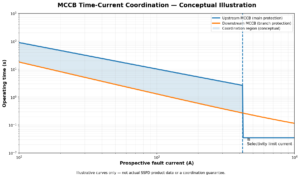
Review the time-current curves of both MCCBs.
The curves help engineers evaluate whether the downstream breaker can operate before the upstream breaker under the relevant fault conditions.
Step 5: Check the Selectivity Limit Current
Determine whether the manufacturer’s selectivity limit is sufficient for the expected fault current.
If total selectivity is required, confirm that the tested coordination data covers the full required fault current range.
Step 6: Verify Cascading Combinations
If cascading is required, check the manufacturer’s tested combination tables for the exact upstream and downstream models, voltage and applicable installation conditions.
6. Practical Example: Coordinating Two MCCBs in an Industrial Distribution System
Consider an industrial factory with a low-voltage distribution panel.
The system contains:
- One upstream MCCB protecting the main distribution circuit.
- Several downstream MCCBs protecting individual production lines.
- Multiple industrial loads connected to separate branch circuits.
The engineering team needs to determine how the upstream and downstream MCCBs should coordinate.
Scenario A: Prioritizing Selectivity
Suppose a short circuit occurs in one production line.
The factory wants to disconnect only the affected branch while keeping other production lines operating.
In this situation, selectivity becomes a priority.
Engineers should examine the trip characteristics of both MCCBs and confirm that the selectivity limit is sufficient for the expected fault current.
Scenario B: Applying Cascading
Now consider a different design requirement.
The prospective short-circuit current at a downstream distribution point is higher than the standalone breaking capacity of the selected downstream MCCB.
The engineering team may evaluate an upstream current-limiting MCCB to improve the short-circuit protection performance of the combination.
The exact combination must be confirmed through manufacturer testing and coordination tables.
Which Strategy Should You Choose?
The decision depends on the primary design objective.
| Project Requirement | Protection Strategy to Evaluate |
|---|---|
| Maintain power supply to unaffected branches | Selectivity |
| Use lower-rated downstream breakers safely | Cascading |
| Optimize both fault isolation and short-circuit protection | Verified coordination combining both capabilities |
The key is to evaluate the complete protective arrangement rather than selecting each MCCB independently.
7. Common Mistakes in MCCB Coordination
Several mistakes can lead to incorrect circuit breaker selection.
1. Assuming Higher Icu Means Better Selectivity
Icu indicates an MCCB’s ultimate breaking capacity, not its coordination performance with another breaker.
2. Assuming MCCBs from the Same Manufacturer Are Automatically Compatible
Coordination depends on the specific models, trip characteristics and tested combinations.
3. Applying Cascading Without Verification
An upstream MCCB does not automatically improve the breaking capacity of every downstream MCCB. The combination must be validated.
4. Ignoring Trip Unit Settings
Incorrect protection settings may result in unnecessary upstream tripping or insufficient fault protection.
5. Confusing Breaking Capacity with Selectivity
A breaker may have a high breaking capacity but still fail to provide the required selectivity with an upstream device.
8. How to Choose an MCCB Manufacturer for Coordination Requirements?
For switchgear manufacturers, electrical contractors and industrial project buyers, choosing a suitable MCCB supplier involves more than comparing current ratings and prices.
A reliable manufacturer should provide clear technical information to support system coordination, including:
- MCCB datasheets and electrical specifications.
- Time-current characteristic curves.
- Rated short-circuit breaking capacity.
- Selectivity coordination tables.
- Cascading or backup protection tables, where available.
- Technical support for product selection and coordination.
For projects involving multiple MCCBs, buyers should provide their system voltage, upstream and downstream breaker models, and prospective short-circuit current when requesting technical assistance.
SSPD provides AC MCCB solutions for industrial distribution and switchgear applications. Customers can contact our team to discuss product specifications and suitable configurations for their projects.
Frequently Asked Questions
1. What is the difference between selectivity and cascading?
Selectivity focuses on ensuring that the circuit breaker closest to a fault operates without unnecessarily tripping upstream breakers. Cascading uses the current-limiting capability of an upstream breaker to improve the short-circuit protection capability of downstream breakers.
2. Does selectivity mean only the downstream MCCB will trip?
Within the specified selectivity range, yes. The downstream MCCB interrupts the fault without causing the upstream MCCB to operate. However, beyond the selectivity limit current, this performance cannot be guaranteed.
3. What is total selectivity and partial selectivity?
Total selectivity means that the downstream breaker operates without causing the upstream breaker to trip throughout the specified applicable range. Partial selectivity means this coordination is guaranteed only up to a specified current limit, known as Is.
4. Can cascading increase the breaking capacity of a downstream MCCB?
Yes. A verified cascading combination can allow a downstream MCCB with a lower standalone breaking capacity to be used at a location with a higher prospective short-circuit current. The combination must be tested and approved by the manufacturer for the applicable conditions.
5. Does a higher Icu guarantee better selectivity?
No. Icu indicates the ultimate short-circuit breaking capacity of an individual circuit breaker. Selectivity depends on the coordination of the operating characteristics of upstream and downstream protective devices.
6. Can two MCCBs from different manufacturers be coordinated?
It may be possible through appropriate engineering evaluation, but compatibility should never be assumed. Manufacturer coordination data or appropriate combination testing is necessary to establish the required protection performance.
7. How do I verify selectivity between two MCCBs?
Check the time-current characteristics, trip settings and manufacturer selectivity tables. Compare the selectivity limit current with the prospective short-circuit current at the installation point to determine whether the required level of selectivity can be achieved.
Conclusion
Selectivity and cascading are two important techniques in low-voltage circuit breaker coordination. Selectivity focuses on isolating faults while maintaining power continuity, whereas cascading improves short-circuit protection through upstream current limitation. Understanding their differences helps engineers select suitable MCCB combinations and design more reliable electrical distribution systems.
About SSPD
SSPD specializes in low-voltage electrical protection products, including MCCB, ACB, MCB, MPCB and AC contactors. With manufacturing capabilities and international B2B experience, SSPD provides circuit protection solutions for distributors, switchgear manufacturers and industrial projects worldwide.
About the Author
Jimmy Zheng
International Business Manager at SSPD
Jimmy Zheng has more than 10 years of experience in low-voltage electrical products and international B2B business. He works with electrical distributors, switchgear manufacturers and industrial customers worldwide, focusing on circuit protection solutions, product selection and international sourcing.
His articles share practical insights from the low-voltage electrical industry and international customer requirements.
Technical Review: SSPD Engineering Team
To be completed after technical verification of the article.