What Is Selectivity in Circuit Breakers and Why Is It Important?
By Jimmy Zheng | International Business Manager at SSPD
Quick Answer: What Is Selectivity in Circuit Breakers?
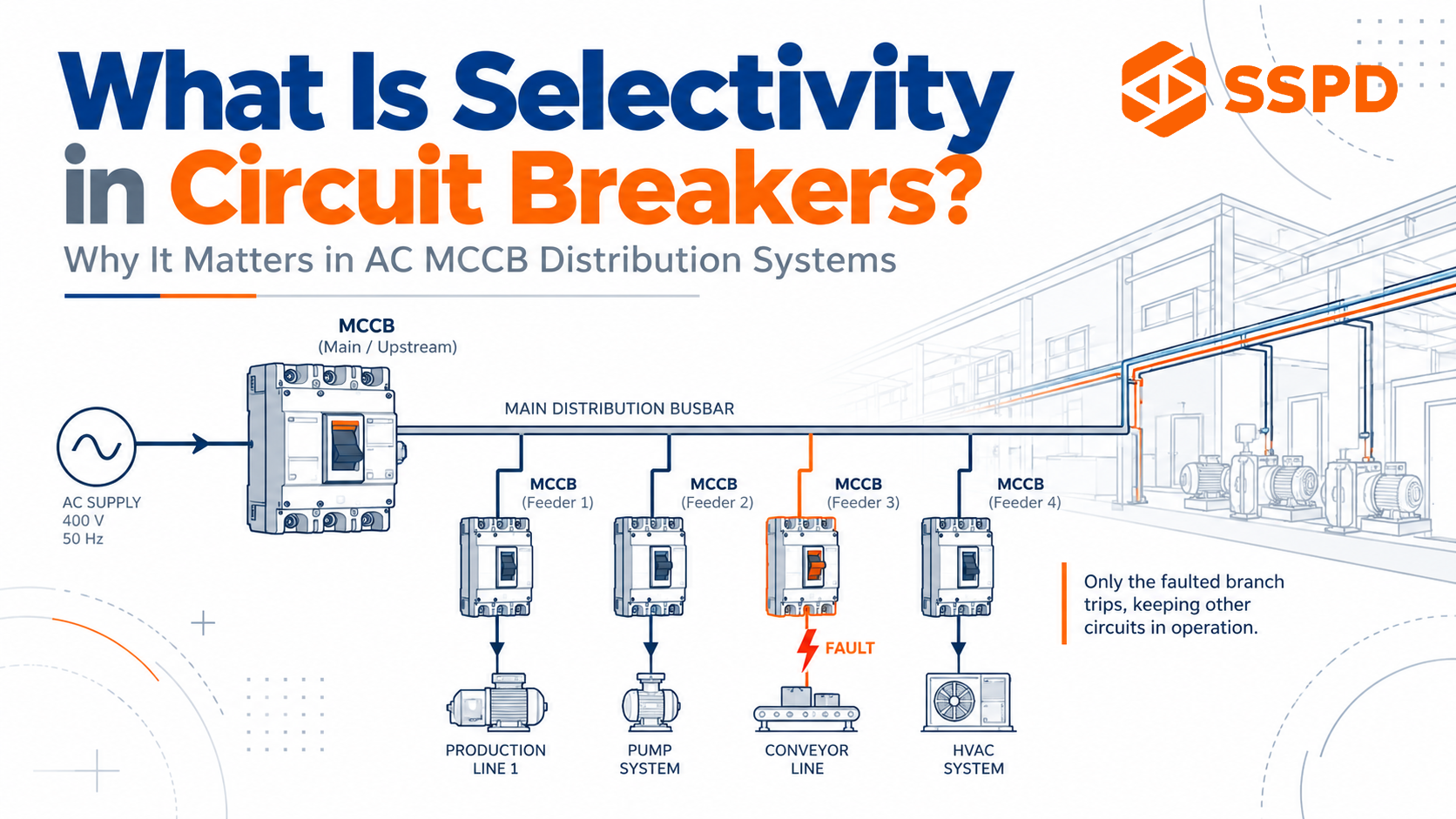
Circuit breaker selectivity is the coordination of two or more protective devices so that the circuit breaker closest to a fault interrupts the fault current without unnecessarily tripping upstream breakers. In low-voltage AC systems, proper MCCB selectivity helps isolate faults, maintain power to unaffected circuits, and improve electrical system availability. Selectivity must be verified for the actual breaker combination and prospective fault-current range.
Why Is Circuit Breaker Selectivity Important?
In an industrial facility, a short circuit in one production line should not automatically shut down the entire factory. However, if the upstream and downstream circuit breakers are not properly coordinated, both devices may trip during the same fault, interrupting power to equipment that is operating normally.
This can lead to production downtime, interrupted processes, difficult fault diagnosis, and unnecessary maintenance work. For facilities with continuous production requirements, such as manufacturing plants, commercial buildings, and infrastructure projects, the consequences can extend beyond the original electrical fault.
Circuit breaker selectivity addresses this problem by coordinating the protective devices within a distribution system. When a fault occurs, the downstream breaker should clear it while the upstream breaker remains closed, provided the fault falls within the verified selectivity range.
For engineers, switchgear manufacturers, and electrical equipment buyers, understanding selectivity is therefore an important part of designing or specifying a reliable low-voltage AC distribution system.
How Does Selectivity Work Between AC MCCBs?
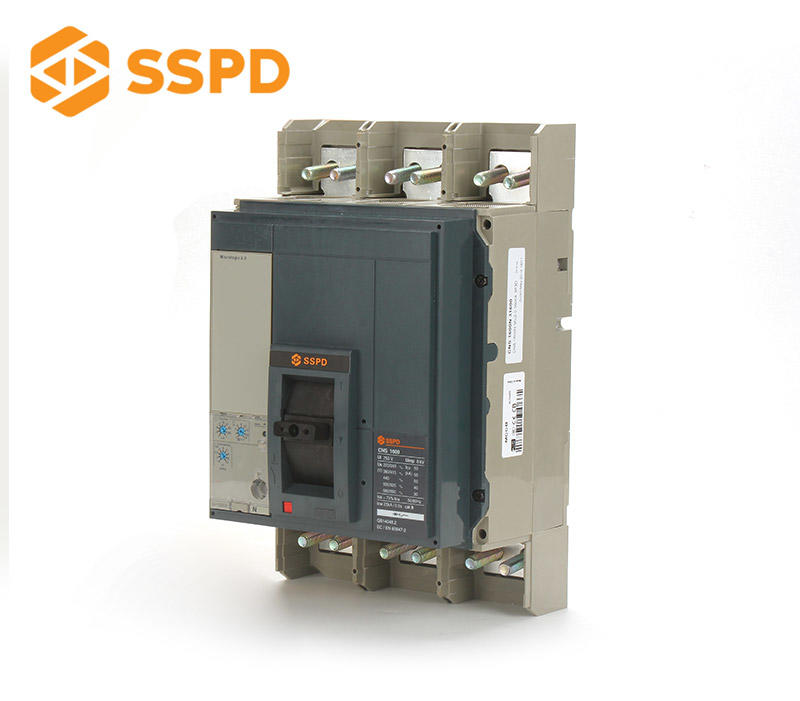
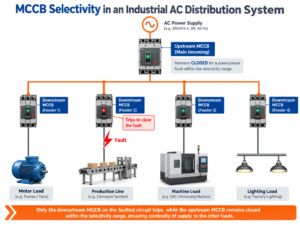
Molded case circuit breakers (MCCBs) are commonly installed at different levels of an AC distribution system. An upstream MCCB protects a main feeder or distribution section, while downstream MCCBs protect individual branches or equipment.
Consider a factory distribution panel with one main MCCB supplying several branch MCCBs.
If a short circuit occurs on one branch, the downstream MCCB is intended to interrupt the fault. The upstream MCCB should remain closed so that the other branches can continue receiving power.
Whether this happens depends on the operating characteristics of both breakers.
Three factors are particularly important:
- Rated current and protection settings: The selected ratings and trip settings must suit the loads, conductors, and protection requirements.
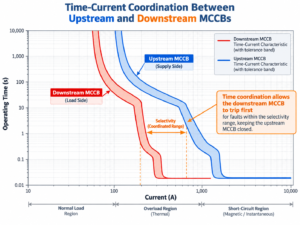
- Time-current characteristics: The downstream breaker must operate without causing the upstream breaker to trip within the intended operating range.
- Short-circuit performance: At high fault currents, instantaneous tripping and current-limiting behavior can affect selectivity. Manufacturer test data or selectivity tables may be necessary to verify the combination.
A larger upstream MCCB does not automatically guarantee selectivity. Two breakers with different rated currents can still trip together during a high-current fault.
The objective is not simply to install a smaller breaker downstream. It is to verify that the selected protective devices coordinate correctly under the expected operating and fault conditions.
Total Selectivity vs. Partial Selectivity
Circuit breaker selectivity is commonly classified as total or partial. The distinction matters because a system may provide selectivity under ordinary overloads and some short-circuit conditions but lose it when the fault current becomes higher.
| Feature | Total selectivity | Partial selectivity |
|---|---|---|
| Operating range | Selectivity is maintained across the specified fault-current range of the installation | Selectivity is maintained only up to a specified current limit |
| Fault current above the limit | Remains selective within the verified range | Simultaneous tripping of upstream and downstream devices may occur |
| Verification | Confirm the complete required fault-current range | Identify and verify the selectivity limit current |
| Application consideration | Suitable when continuity requirements justify the design and the combination is verified | May be acceptable when the required protection and continuity conditions are satisfied |
What Is the Selectivity Limit Current?
The selectivity limit current, commonly denoted by Is, is the upper current limit up to which a particular combination of protective devices maintains selectivity.
For example, suppose the manufacturer’s documentation establishes a selectivity limit of 15 kA for a particular upstream and downstream MCCB combination under specified conditions.
This means selectivity is verified up to 15 kA for that combination and those conditions. It does not mean the breakers will necessarily operate selectively at 20 kA.
The value must be obtained from applicable manufacturer data or appropriate verification. It should not be estimated solely from the difference between the breakers’ rated currents.
When total selectivity is required, engineers must verify the applicable fault-current range against the installation’s prospective short-circuit current and the breakers’ ratings.
What Are the Main Selectivity Methods for AC MCCBs?
Several coordination approaches can be used in low-voltage AC distribution systems. The appropriate method depends on the circuit breakers, their trip units, the fault-current levels, and the system’s continuity requirements.
1. Current Selectivity
Current selectivity relies on differences in the current thresholds at which protective devices operate.
The downstream breaker is configured to respond to faults within its protected branch, while the upstream breaker is set so that it does not operate for the same faults within the intended coordination range.
This method can be effective when the fault-current levels seen at different points in the system are sufficiently different. However, its effectiveness depends on the actual circuit impedance, protection characteristics, and maximum prospective fault current.
It should not be assumed that different instantaneous trip thresholds will provide complete selectivity at every short-circuit level.
2. Time Selectivity
Time selectivity uses a deliberate operating delay in the upstream protection, allowing the downstream breaker time to clear a fault first.
For example, an upstream MCCB with a suitable short-time delay may allow a downstream MCCB to interrupt a branch fault before the upstream device operates.
This approach can improve coordination in distribution systems with appropriately configured electronic trip units.
However, the delay must remain compatible with the installation’s short-circuit withstand capability and protection requirements. Protection settings should not be changed without checking the complete system design.
3. Energy Selectivity
Energy selectivity takes advantage of the current-limiting and energy-limiting characteristics of circuit breakers.
During a short circuit, a current-limiting breaker can restrict the peak current and the energy passing through it. The interaction between the upstream and downstream devices can therefore influence whether both breakers trip.
Energy selectivity cannot be reliably determined simply by comparing current ratings or looking at ordinary time-current curves. For many MCCB combinations, manufacturer-specific tables or test data are needed.
4. Zone-Selective Interlocking (ZSI)
Some electronic protection systems support zone-selective interlocking.
In a supported arrangement, protective devices exchange signals to coordinate their response to a fault. This can allow the downstream device closest to the fault to operate quickly while the upstream device follows the configured coordination logic.
ZSI is not available on every MCCB or trip unit. Its implementation depends on the specific equipment, wiring, settings, and manufacturer’s instructions.
For buyers specifying electronic MCCBs, it is important to confirm whether this feature is available and whether it is suitable for the intended distribution system.
How to Check Selectivity Between Two MCCBs
Before specifying MCCBs for an industrial distribution panel, engineers should verify the coordination of the actual devices rather than relying on general rules of thumb.
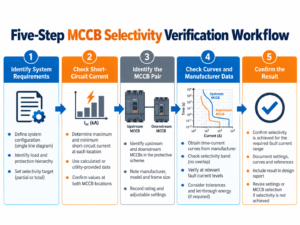
The following process provides a practical starting point.
Step 1: Identify the System Requirements
Collect the basic electrical information:
- System voltage and frequency
- Earthing arrangement and distribution configuration
- Load characteristics
- Prospective short-circuit current at relevant installation points
- Required continuity of supply
- Applicable design and installation requirements
The prospective short-circuit current is especially important because selectivity must be assessed against the fault levels the system can actually experience.
Step 2: Identify Both MCCBs
Record the exact upstream and downstream breaker models, including:
- Frame size and rated current
- Rated operational voltage
- Ultimate and service short-circuit breaking capacities, where applicable
- Trip unit type
- Adjustable protection settings
- Relevant manufacturer coordination data
Two MCCBs with similar ratings may have different tripping and current-limiting characteristics. The exact device combination matters.
Step 3: Review the Protection Settings
Check the overload, short-time, and instantaneous protection settings supported by the selected breakers.
Where applicable, compare the time-current curves and account for operating tolerances. A visible separation between curves can help assess coordination, but it does not necessarily prove selectivity at high short-circuit currents.
Any adjustment must remain within the manufacturer’s permitted settings and the installation’s protection requirements.
Step 4: Check Manufacturer Selectivity Tables
For many MCCB combinations, especially in the high-current short-circuit region, manufacturer selectivity tables provide essential information.
Confirm that the documented combination matches the actual upstream and downstream devices, voltage, and relevant configuration. Check the stated selectivity limit and compare it with the prospective fault current at the downstream installation point.
Do not assume that data for one breaker combination applies to a different model, trip unit, or manufacturer.
Step 5: Confirm the Result Against the Design Requirements
The final check is whether the verified selectivity range meets the project’s requirements.
If the available combination does not provide sufficient selectivity, the design may need different breakers, revised permitted protection settings, or another coordination approach.
The completed design should also satisfy the required breaking capacity, cable protection, short-circuit withstand, and other applicable safety requirements.
Common Mistakes in MCCB Selectivity Coordination
Several common assumptions can lead to incorrect protection coordination.
Mistake 1: Assuming a higher-rated upstream MCCB guarantees selectivity.
A higher upstream current rating alone does not establish selective operation. Trip characteristics, short-circuit behavior, and the verified device combination must also be considered.
Mistake 2: Assuming that separated time-current curves prove selectivity under all conditions.
Curves are useful, but high-current faults can involve instantaneous tripping and current-limiting effects that are not adequately established by a simple visual comparison. Additional manufacturer data may be necessary.
Mistake 3: Confusing selectivity with cascading.
Selectivity aims to isolate a fault using the intended downstream protective device while upstream devices remain closed within the verified range.
Cascading, also called back-up protection in this context, uses a tested combination in which an upstream protective device helps a downstream device safely interrupt fault currents that may exceed the downstream device’s standalone breaking capability. Cascading does not, by itself, guarantee that only the downstream breaker will trip.
Mistake 4: Choosing MCCBs based only on price and rated current.
A suitable selection must consider electrical performance, required coordination, product documentation, and the installation’s actual fault conditions. The least expensive breaker is not necessarily the appropriate choice for a system requiring verified selectivity.
How to Choose an MCCB Manufacturer for Selective Coordination
For electrical wholesalers, switchgear manufacturers, and EPC contractors, selecting an MCCB supplier involves more than comparing product prices and current ratings.
When selective coordination is a project requirement, ask the manufacturer for the technical information needed to evaluate the intended breaker combination.
Useful documentation may include:
- Product datasheets and trip-unit specifications
- Time-current characteristic curves
- Short-circuit breaking capacity data
- Selectivity tables for the relevant breaker combinations
- Information about electronic protection functions and supported interlocking features
- Applicable test reports and certifications
Not every manufacturer publishes the same level of coordination data. If a required combination cannot be verified from the available documentation, request clarification rather than assuming that selectivity is guaranteed.
SSPD supplies low-voltage electrical protection products, including molded case circuit breakers (MCCBs), air circuit breakers (ACBs), miniature circuit breakers (MCBs), and AC contactors. For project-specific MCCB requirements, buyers should identify the required system voltage, current rating, fault level, and protection functions so that the suitability of the proposed configuration can be assessed.
Need help identifying the right MCCB configuration? Contact the SSPD team with your project requirements and the relevant electrical specifications.
Frequently Asked Questions
1. What Is Selectivity in Circuit Breakers?
Selectivity is the coordination of protective devices so that the device intended to clear a fault operates while upstream devices remain closed within the verified operating range. It helps limit the area affected by an electrical fault.
2. What Is the Difference Between Total and Partial Selectivity?
Total selectivity means selective operation is maintained across the specified fault-current range of the installation. Partial selectivity means it is maintained only up to a defined current limit, beyond which selective operation is not guaranteed.
3. How Do You Achieve Selectivity Between Two MCCBs?
Selectivity can be achieved through suitable current thresholds, time delays, energy-based coordination, or supported interlocking functions. The actual method depends on the breaker characteristics, fault-current levels, protection settings, and verified manufacturer data.
4. Does a Higher-Rated Upstream MCCB Guarantee Selectivity?
No. A higher rated current upstream does not guarantee selective operation. The exact breaker combination, trip characteristics, short-circuit behavior, and available coordination data must be checked.
5. What Is the Difference Between Selectivity and Cascading?
Selectivity concerns which protective device operates to isolate a fault. Cascading uses a verified upstream/downstream protective-device combination to improve the downstream device’s short-circuit interruption capability under specified conditions. Cascading alone does not guarantee that only the downstream device trips.
6. How Can I Check Selectivity Between AC MCCBs?
Identify the exact MCCB models and settings, determine the prospective short-circuit current, review the protection curves, and consult the manufacturer’s selectivity tables or test data. Confirm that the verified range satisfies the installation requirements.
Conclusion
AC MCCB selectivity is an important part of low-voltage distribution design because it helps isolate electrical faults while maintaining power to unaffected circuits. Achieving it requires more than selecting different current ratings: engineers must evaluate fault levels, trip characteristics, device settings, and verified coordination data.
For reliable results, select MCCBs according to the actual application and confirm the proposed combination against the manufacturer’s technical documentation.
About the Author
Jimmy Zheng
International Business Manager at SSPD
Jimmy Zheng has more than 10 years of experience in low-voltage electrical products and international B2B business. His work focuses on circuit protection solutions, including MCCBs, ACBs, MCBs, and AC contactors, supporting the needs of electrical distributors, switchgear manufacturers, and industrial buyers.
His articles aim to help international customers understand product specifications, evaluate technical requirements, and make better-informed sourcing decisions.
Technical Review
SSPD Engineering Team
Technical review should confirm the accuracy of the protection principles, terminology, and any product-specific claims before publication.
Further Reading and Technical Resources
Explore the following resources to learn more about MCCB selection, circuit breaker selectivity, and low-voltage protection coordination.
- SSPD MCCB Products — Explore molded case circuit breakers for low-voltage AC distribution and industrial protection applications.
- How to Select the Right MCCB for Industrial Applications — Learn how rated current, breaking capacity, voltage rating, and protection requirements influence MCCB selection.
- Low-Voltage Selectivity with ABB Circuit Breakers — Learn about selectivity principles and coordination between low-voltage protective devices.