How to Select the Right MCCB for Industrial Applications?

Quick Answer: How Do You Select the Right MCCB?
An MCCB should be selected based on rated current, breaking capacity, operating voltage, protection characteristics, and actual application conditions. Engineers should evaluate the load current, prospective short-circuit current, cable capacity, installation environment, and required standards before choosing a molded case circuit breaker for an industrial system.
Why Choosing the Right MCCB Matters
In industrial electrical systems, selecting the wrong MCCB can lead to nuisance tripping, insufficient fault protection, equipment damage, production downtime, and increased safety risks.
Choosing the correct molded case circuit breaker is not simply a matter of matching the breaker current rating to the load. The MCCB must work together with the cable, downstream equipment, upstream protection, and overall power distribution system.
This guide explains the main technical factors engineers, switchgear manufacturers, distributors, and project buyers should consider when selecting an MCCB for industrial applications.
What Is an MCCB?
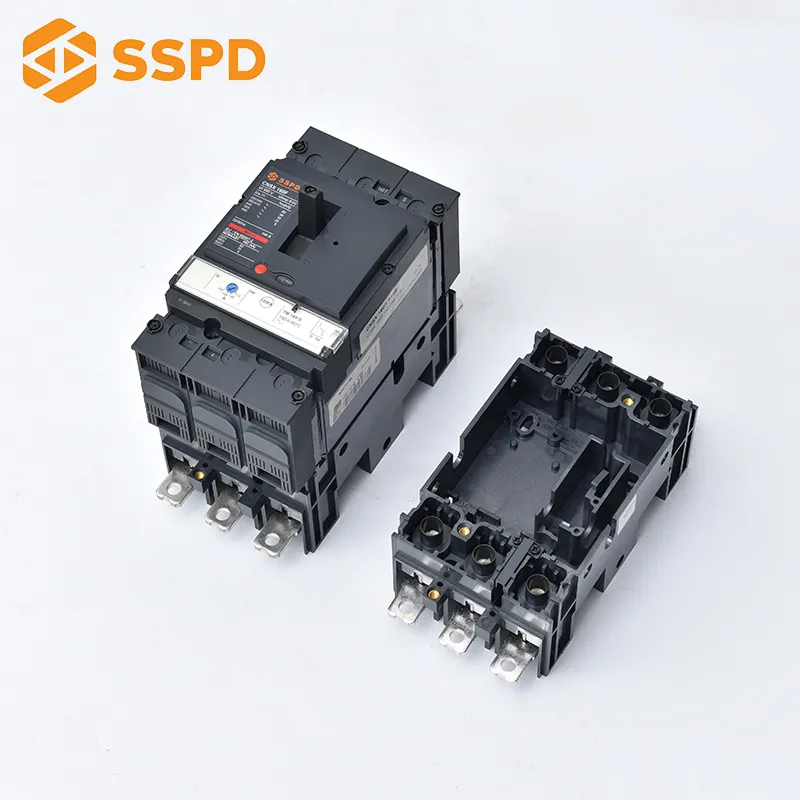
A Molded Case Circuit Breaker (MCCB) is a low-voltage circuit protection device designed to interrupt current automatically when abnormal electrical conditions occur.
Its main protection functions normally include:
- Overload protection
- Short-circuit protection
- Circuit isolation
- Optional adjustable or electronic protection functions
Compared with an MCB, an MCCB is generally used for higher-current and higher-fault-level applications. MCCBs also provide a wider range of frame sizes, breaking capacities, trip-unit options, and accessories.
They are commonly installed in:
- Industrial distribution panels
- Main distribution boards
- Motor control centers
- Commercial buildings
- Infrastructure projects
- Switchgear assemblies
Depending on the series and application, industrial MCCBs may cover current ratings from approximately 15A to 1250A, operating voltages up to 690V AC, and a wide range of breaking capacities.
MCCB Internal Structure Explained
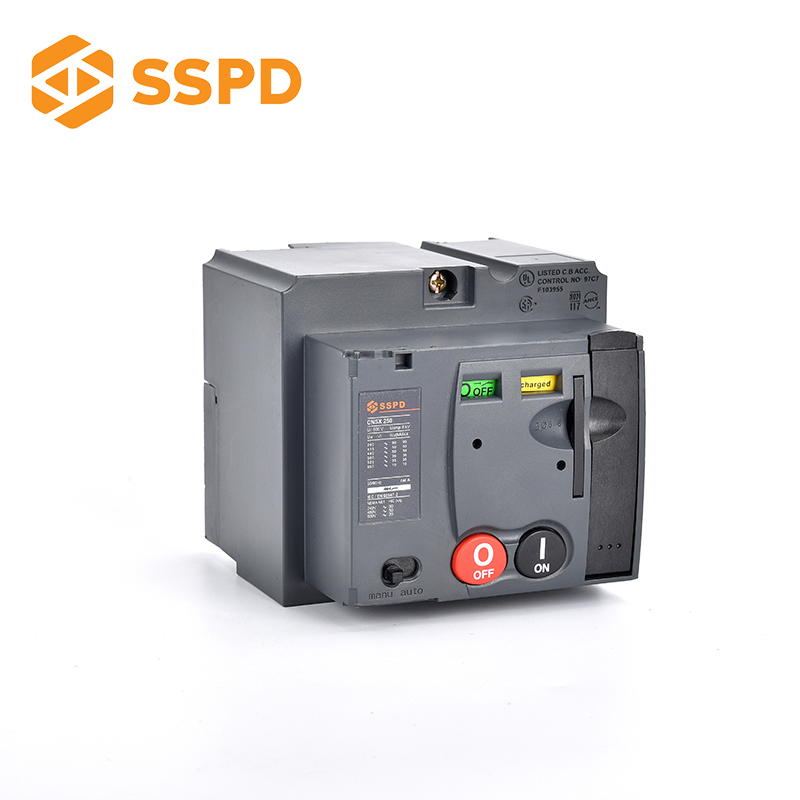
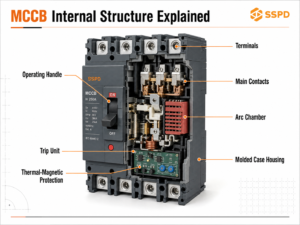
A typical MCCB contains several important components:
- Operating handle — manually opens, closes, or resets the breaker.
- Main contacts — carry the normal operating current and separate when the breaker trips.
- Arc chamber — helps divide, cool, and extinguish the electrical arc created when the contacts open.
- Trip unit — detects abnormal current conditions and activates the operating mechanism.
- Thermal-magnetic or electronic protection system — provides overload and short-circuit protection.
- Terminals — connect the MCCB to incoming and outgoing conductors.
- Molded case housing — provides insulation, mechanical protection, and structural support.
How Does an MCCB Work?
An MCCB monitors current flowing through the circuit and disconnects the power when electrical conditions exceed the designed protection settings.
The exact operating principle depends on the trip unit.
Thermal Protection
Thermal protection is mainly used for overload protection.
When current remains above the acceptable operating level for a period of time, the thermal element heats up and eventually activates the trip mechanism.
Magnetic Protection
Magnetic protection reacts much faster and is designed mainly for high short-circuit currents.
During a severe short circuit, current can rise rapidly. The magnetic trip mechanism responds almost instantaneously and opens the circuit to reduce the duration of the fault.
Electronic Trip Protection
Electronic MCCBs use sensors and electronic trip units to provide more accurate and flexible protection.
Depending on the trip unit, adjustable functions may include:
- Long-time protection
- Short-time protection
- Instantaneous protection
- Ground-fault protection
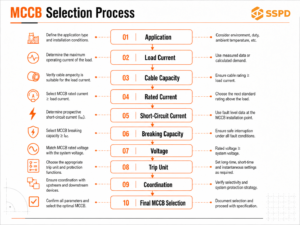
Key Factors for Selecting an MCCB
There is no single MCCB specification that is suitable for every industrial application.
A proper selection should consider the following factors together.
1. Rated Current
Rated current is usually the first parameter buyers check, but it should not be the only one.
The MCCB must be able to carry the expected operating current under actual installation conditions.
For example, if a circuit normally carries approximately 200A, it does not automatically mean that a 200A MCCB is always the correct choice.
Engineers should also evaluate:
- Continuous operating current
- Cable current-carrying capacity
- Ambient temperature
- Installation method
- Load characteristics
- Future expansion requirements
- Trip-unit adjustment range
2. Breaking Capacity: Icu and Ics
Breaking capacity is one of the most important parameters in industrial MCCB selection.
A breaker must be capable of safely interrupting the maximum prospective short-circuit current available at its installation point.
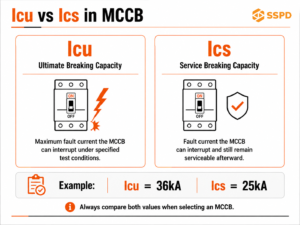
Icu — Ultimate Short-Circuit Breaking Capacity
Icu indicates the maximum short-circuit current that the breaker can interrupt under specified test conditions.
For example:
Icu = 36kA at 415V AC
means the breaker has been tested to interrupt a short-circuit current up to 36kA under the specified standard conditions.
Ics — Service Short-Circuit Breaking Capacity
Ics indicates the level of short-circuit current the breaker can interrupt while still meeting specified service-performance requirements afterward.
For applications where continuity of service is important, Ics deserves particular attention.
A common purchasing mistake is comparing two MCCBs only by:
- Frame size
- Rated current
- Price
while ignoring their breaking capacity.
3. Operating Voltage
The MCCB rated operational voltage must be suitable for the electrical system where it will be installed.
Common industrial low-voltage systems include:
- 380V AC
- 400V AC
- 415V AC
- 440V AC
- 480V AC
- 690V AC
4. Protection Characteristics
The correct trip-unit type depends on how much adjustability and coordination the system requires.
Thermal-Magnetic MCCB
Thermal-magnetic MCCBs are suitable for many standard industrial and commercial applications.
Electronic MCCB
Electronic trip MCCBs are more suitable when the system requires:
- Adjustable protection settings
- More precise current sensing
- Better selectivity
- Coordination with upstream or downstream breakers
- Additional protection functions
5. Environmental and Installation Conditions
Industrial environments may involve:
- High ambient temperature
- Dust
- Humidity
- Vibration
- High altitude
- Restricted cabinet ventilation
- Frequent switching
- Harsh operating conditions
Common Mistakes When Selecting an MCCB
Mistake 1: Selecting Only by Ampere Rating
Mistake 2: Ignoring Breaking Capacity
Mistake 3: Confusing Frame Current With Actual Trip Setting
Mistake 4: Choosing the Lowest Price Without Comparing Specifications
Real Application Example: Selecting Protection for an Industrial Distribution System
Consider a factory supplied by a 1600kVA transformer with a 400V three-phase low-voltage system.
The approximate transformer full-load current is around 2300A.
However, this number alone is not enough to select the main protective device.
The engineer should evaluate:
- Continuous current
- Breaker current range
- Prospective short-circuit current
- Protection coordination
- Service continuity
Engineering Takeaway
A practical MCCB selection is based on:
Load current + short-circuit level + cable protection + coordination + operating environment + system reliability requirements
MCCB Applications in Industrial Systems
MCCBs are used across a wide range of low-voltage applications, including:
- Industrial factories
- Switchgear assemblies
- Commercial buildings
- Infrastructure projects
How to Choose a Reliable MCCB Manufacturer
For distributors, switchgear companies, EPC contractors, and project buyers, selecting the supplier is part of the technical decision.
A reliable MCCB manufacturer should be able to provide more than a price quotation.
1. Clear Technical Data
2. Consistent Production Capability
SSPD operates approximately 6,000㎡ of manufacturing space with 10 production lines, supporting low-voltage circuit breaker and control-product production.
3. Product Testing and Quality Control
Quality control should cover more than final visual inspection.
Relevant processes may include:
- Incoming material inspection
- Assembly-process control
- Calibration
- Mechanical operation testing
- Electrical performance testing
- Final inspection

4. Technical Communication
For B2B projects, the supplier should be able to discuss more than product codes.
Frequently Asked Questions
What size MCCB do I need?
What is the difference between MCCB and MCB?
How do I choose MCCB breaking capacity?
What is the difference between Icu and Ics?
Can an MCCB be used at 690V?
Is a higher breaking capacity always better?
Should I choose a thermal-magnetic or electronic MCCB?
How should I compare MCCB suppliers?
Conclusion
Selecting the right MCCB requires more than matching a current rating.
For industrial applications, engineers should evaluate:
- Rated current
- Cable capacity
- Breaking capacity
- Operating voltage
- Trip-unit characteristics
- Short-circuit conditions
- Protection coordination
- Installation environment
A correctly selected MCCB helps improve electrical safety, reduce unnecessary downtime, and protect downstream equipment more effectively.
About SSPD
SSPD is a low-voltage electrical product manufacturer specializing in MCCBs, ACBs, MCBs, motor protection circuit breakers, and AC contactors.
With 10 production lines, international export experience, product customization capability, and certification support, SSPD serves electrical distributors, switchgear manufacturers, engineering companies, and industrial buyers in international markets.
Written by: Jimmy Zheng
International Business Manager at SSPD
Jimmy Zheng has more than 10 years of experience in low voltage electrical products and international B2B business. He works closely with electrical distributors, switchgear manufacturers, EPC contractors, and industrial buyers to help them select suitable circuit protection solutions.
Technical Review: SSPD Engineering Team
Reviewed for technical accuracy, product specifications, and compliance with applicable low voltage electrical standards.