How to Choose MCCB Breaking Capacity: 18kA, 25kA, 36kA, 50kA or Higher?
By Jimmy Zheng · Reviewed by SSPD Engineering Team · Updated August 2026

Quick Answer
Choose MCCB breaking capacity according to the prospective short-circuit current at the breaker installation point and verify the Icu rating at the actual system voltage. As a general rule, the MCCB’s Icu should be equal to or greater than the prospective short-circuit current when the breaker is used on its own. A lower standalone Icu may only be used where a verified back-up or cascading combination permits it.
Whether you need 18kA, 25kA, 36kA, 50kA or a higher rating therefore depends on the electrical system—not simply on which breaker has the largest number.
What Does MCCB Breaking Capacity Mean?
MCCB breaking capacity indicates the level of short-circuit current a molded case circuit breaker can interrupt under specified conditions.
For industrial MCCBs covered by IEC 60947-2, two ratings are particularly important:
Icu — Rated Ultimate Short-Circuit Breaking Capacity
Icu indicates the maximum prospective short-circuit current that the breaker can interrupt under the specified test conditions.
A rating such as:
Icu = 36kA at 415V AC
therefore means that the breaker has a rated ultimate breaking capacity of 36kA at that operating voltage.
Ics — Rated Service Short-Circuit Breaking Capacity
Ics describes the breaker’s short-circuit performance under the service breaking test sequence.
It is particularly relevant where continuity of service after a short-circuit event is important.
Two MCCBs can therefore have the same Icu but different Ics ratings, so buyers should not compare breakers using only the largest kA figure. IEC 60947-2 distinguishes these two short-circuit characteristics.
When checking breaking capacity, always confirm three things:
- What is the Icu?
- What is the Ics?
- At what operating voltage are those ratings specified?
The First Rule: Determine the Prospective Short-Circuit Current
The most important input for breaking-capacity selection is the prospective short-circuit current, or PSC, at the exact point where the MCCB will be installed.
PSC is not the normal load current.
It represents the current that could flow if a short circuit occurred at that location.
It is influenced by factors including:
- Transformer capacity
- Transformer impedance
- Upstream supply strength
- System voltage
- Cable and busbar impedance
- Distance from the transformer
- Network configuration
This is why two circuits carrying the same normal operating current can require very different MCCB breaking capacities.
General Selection Principle
When an MCCB must interrupt the fault on its own:
Icu at the applicable operating voltage should be equal to or greater than the prospective short-circuit current at the installation point.
However, there is an important exception.
A downstream breaker with a lower standalone Icu may sometimes be used when it forms part of a tested and documented back-up or cascading combination with an upstream protective device.
Therefore:
PSC > MCCB standalone Icu
does not automatically mean that every possible coordinated system is invalid—but it does mean the lower-rated breaker cannot simply be selected as a standalone device without verified back-up data.
This distinction is important in professional MCCB selection.
Illustrative Example: 28kA Prospective Short-Circuit Current
Consider a simplified selection example:
- System voltage: 400/415V AC
- Prospective short-circuit current: 28kA
If the breakers are being evaluated on their standalone Icu ratings, the result is:
| MCCB Icu | Standalone assessment at 28kA PSC |
|---|---|
| 18kA | Insufficient |
| 25kA | Insufficient |
| 36kA | Meets the basic Icu criterion |
| 50kA | Meets the basic Icu criterion |
| 70kA | Meets the basic Icu criterion |
This immediately eliminates 18kA and 25kA as standalone options.
But it does not automatically mean that 50kA is better than 36kA.
The next questions include:
- What Ics is required?
- Is selective coordination required?
- Is verified cascading being used?
- Will the system be expanded later?
- Does the project specification require a higher rating?
- Is the additional cost justified?

This is the central principle of breaking-capacity selection:
First eliminate ratings that cannot safely interrupt the expected fault. Then compare the technically suitable options.
18kA vs 25kA vs 36kA vs 50kA: What Is the Difference?
The numbers describe progressively higher short-circuit interruption capability.
They should not be treated as fixed labels such as “commercial,” “industrial” or “heavy industrial.”
Actual system conditions determine the required rating.
When Can an 18kA MCCB Be Suitable?
An 18kA breaker may be appropriate when the calculated prospective short-circuit current is sufficiently below its rated breaking capacity and the remaining protection requirements are satisfied.
Lower available fault currents may be found:
- Farther downstream from the transformer
- Where cable impedance is significant
- In systems with comparatively higher source impedance
- At distribution points with relatively low available fault levels
But one common misconception should be avoided:
Low load current does not necessarily mean low short-circuit current.
A 100A circuit close to a large transformer may face a higher PSC than a larger load located much farther away.
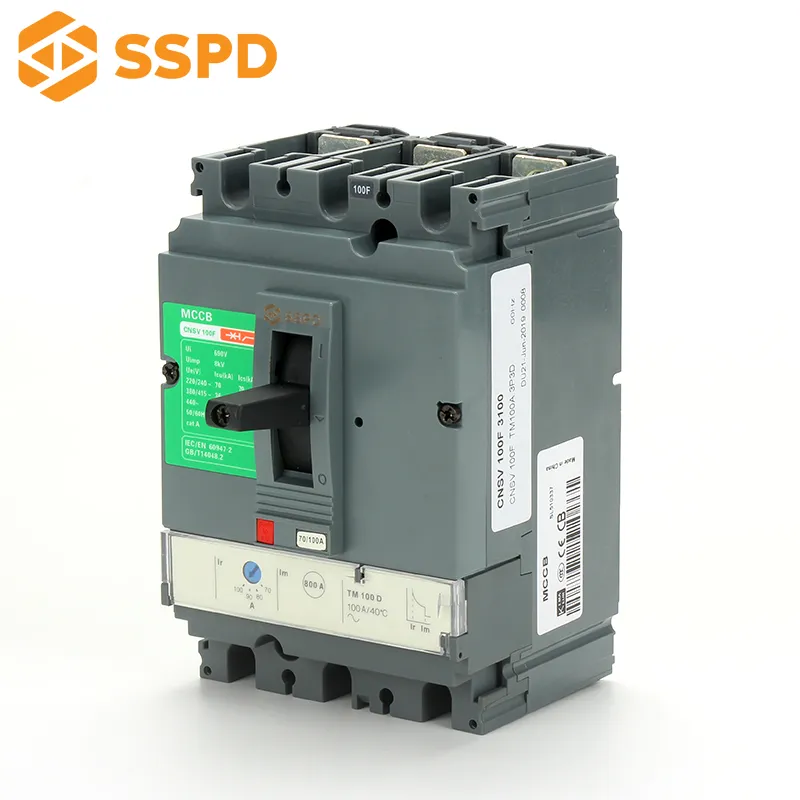
SSPD’s CEZC product range provides an example of how manufacturers offer different breaking-capacity levels within the same MCCB family. According to the product catalogue, CEZC250 is available in 18kA F, 25kA N and 36kA H versions.
When Does 25kA Become Appropriate?
25kA provides higher interruption capability than 18kA.
If the PSC is, for example, 15kA, both an appropriately rated 18kA and a 25kA breaker may potentially satisfy the standalone Icu criterion.
But if the calculated PSC is 23–24kA, the decision deserves greater engineering attention.
The designer may need to consider:
- Accuracy and assumptions of the short-circuit calculation
- Project requirements
- Ics
- System expansion
- Upstream and downstream coordination
There is no universal rule such as:
“Always add 20% to the calculated fault current.”
The required design margin should follow the applicable project requirements and engineering assumptions rather than an arbitrary percentage.
When Is 36kA a Better Choice?
A 36kA breaking capacity becomes necessary when lower ratings no longer satisfy the required short-circuit performance, or when the design specification calls for that level.
It may commonly appear in:
- Industrial distribution systems
- Panels closer to transformers
- Systems with larger transformer capacities
- Networks with lower total impedance
But 36kA should not automatically be described as “the industrial rating.”
SSPD’s catalogue illustrates this clearly.
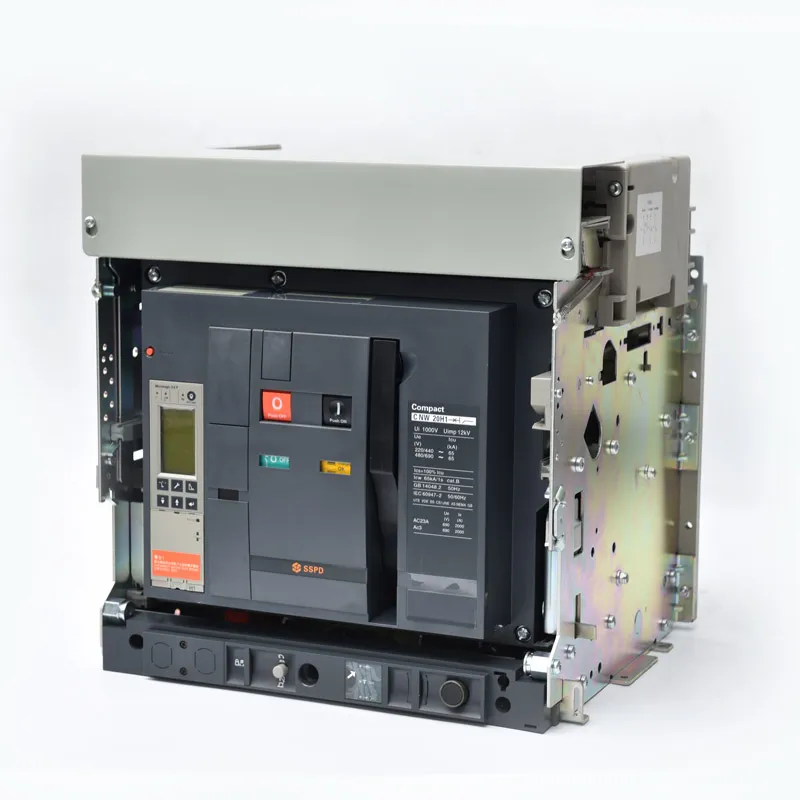
CEZC provides 36kA options, while the higher-performance CNSX series also starts with a 36kA F breaking-capacity level at 380/415V.
The same kA rating can therefore appear in different breaker families and frame sizes.
When Is 50kA or Higher Required?
50kA or higher ratings become relevant where available fault current is greater or where project requirements demand greater short-circuit performance.
Possible applications include:
- Main distribution boards
- Larger transformers
- Low-impedance systems
- Distribution equipment installed close to transformers
- High-fault-level industrial systems
- Projects with specified minimum fault ratings
SSPD’s catalogue, for example, lists:
- CEZC400/630 H: 50kA
- CNSX N: 50kA at 380/415V
- CNSX H: 70kA at 380/415V
The existence of 50kA or 70kA products does not mean they should automatically replace lower-rated breakers.
It means they are available for systems that require greater short-circuit interruption capability.
Is Higher MCCB Breaking Capacity Always Better?
No.
This is one of the most important purchasing points to understand.
Suppose a system has:
PSC = 12kA
From the standalone Icu perspective:
- 18kA may satisfy the requirement
- 25kA may satisfy it
- 36kA may satisfy it
- 50kA may satisfy it
A 50kA MCCB does not provide “almost three times better protection” than an 18kA MCCB simply because its kA rating is almost three times higher.
Breaking capacity describes fault interruption capability, not an overall protection-quality multiplier.
Choosing a higher rating can also involve:
- Higher cost
- A different breaker series
- Different dimensions
- Different accessories or installation requirements
- Unnecessary over-specification
A higher rating may still be justified when:
- Future system expansion is planned
- Transformer capacity may increase
- The project specifies a minimum rating
- Standardizing one breaker level across multiple panels is desirable
- Ics or coordination requirements favour another model
The correct goal is therefore:
Adequate breaking capacity with appropriate system margin—not simply maximum breaking capacity.
Why Operating Voltage Matters
A breaking-capacity value is incomplete if the applicable voltage is not stated.
You should not compare:
“50kA MCCB”
with another:
“50kA MCCB”
until you know that both values apply at the same voltage.
Breaking capacity can decrease as operating voltage increases.
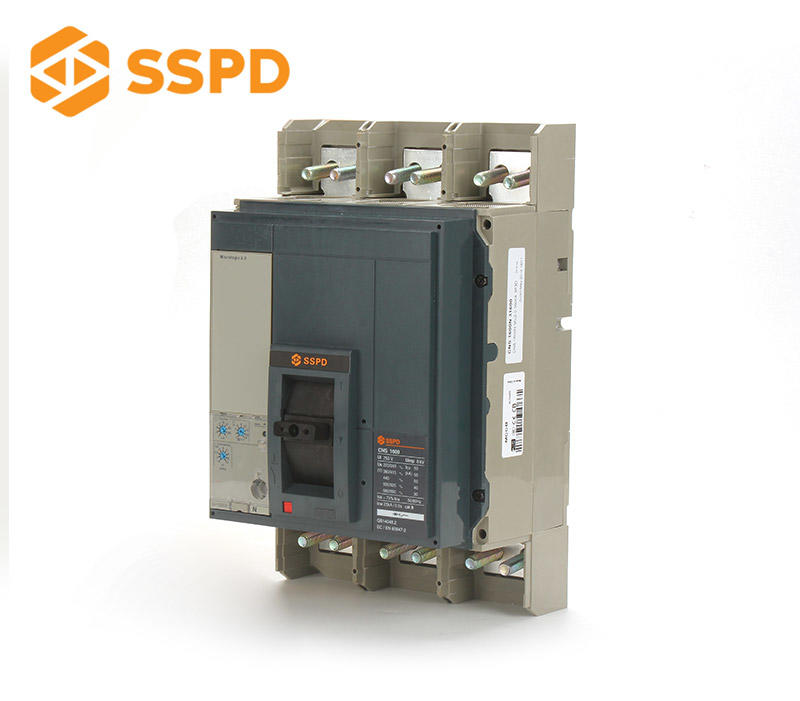
The SSPD CNS 800–1600 product data provides a useful illustration:
| Operating Voltage | N Icu | H Icu |
|---|---|---|
| 220/240V | 85kA | 85kA |
| 380/415V | 50kA | 70kA |
| 440V | 50kA | 65kA |
| 500/525V | 40kA | 50kA |
| 660/690V | 30kA | 42kA |
These are published product ratings from the SSPD catalogue, not application examples.
Notice the H version:
70kA at 380/415V → 42kA at 660/690V

It is the same product family, but the available breaking capacity differs substantially with operating voltage.
This gives buyers a very practical rule:
Never approve an MCCB only from a “kA” value. Always ask for Icu and Ics at the actual system voltage.
Why Ics Should Not Be Ignored
Icu usually gets more attention because it represents the ultimate short-circuit capability.
But Ics can also be important, particularly when continuity of service matters.
SSPD’s CNSX catalogue provides a straightforward example.
At 380/415V, the CNSX F, N and H versions are specified as:
| Version | Icu | Ics |
|---|---|---|
| F | 36kA | 36kA |
| N | 50kA | 50kA |
| H | 70kA | 70kA |
These are catalogue/test specification values.
The purpose of showing this table is not to present CNSX as a “case study.”
It demonstrates why a buyer should request both Icu and Ics, instead of receiving only a single breaking-capacity number from the supplier.
Can Transformer Size Alone Tell You Which kA Rating to Use?
No.
Knowing that a project uses a 630kVA, 1000kVA or 1600kVA transformer is useful, but transformer kVA alone is not enough to select MCCB breaking capacity.
Short-circuit current also depends on factors such as:
- Transformer percentage impedance
- System voltage
- Upstream source characteristics
- Cable or busbar impedance
- Distance between transformer and breaker
- Network configuration
Therefore, a statement such as:
“1000kVA transformer = 50kA MCCB”
is not a reliable general design rule.
The prospective short-circuit current should first be calculated or provided by the system designer.
How to Choose MCCB Breaking Capacity Step by Step
A practical selection process is:
Step 1 — Confirm the Operating Voltage
Determine whether the system is:
- 380V
- 400/415V
- 440V
- 500/525V
- 660/690V
- or another voltage
Step 2 — Determine PSC at the Installation Point
Use the electrical system calculation or project data.
Do not estimate breaking capacity from load current alone.
Step 3 — Check Standalone Icu
Select a breaker whose applicable Icu can interrupt the calculated PSC when it is required to operate independently.
Step 4 — Check Ics
Review the required service short-circuit performance, particularly where operational continuity is important.
Step 5 — Check Selectivity and Coordination
Evaluate how the MCCB works with upstream and downstream protective devices.
Step 6 — Check Back-Up/Cascading if Applicable
If the downstream MCCB’s standalone Icu is lower than the available PSC, only use that arrangement when the specific upstream/downstream combination has been tested and documented for the required back-up protection.
Step 7 — Compare Commercially Suitable Products
After technical requirements are established, compare:
- Frame size
- Rated current
- Trip unit
- Poles
- Accessories
- Dimensions
- Price
- Lead time
In other words:
Select the electrical requirement first, then select the product—not the other way around.
SSPD MCCB Breaking Capacity Options
SSPD offers different MCCB families for different current and breaking-capacity requirements.
According to the current product catalogue:
| Series | Current Range | Breaking Capacity Reference |
|---|---|---|
| CEZC | 15–630A | CEZC250: 18/25/36kA; CEZC400/630: 36/50kA |
| CNSX | 16–630A | 36/50/70kA Icu at 380/415V |
| CNS | 800–1600A | 50/70kA at 380/415V, with ratings varying by voltage |
This range allows the breaker to be matched to the electrical system rather than forcing every project into one breaking-capacity level.
For a broader explanation of current rating, voltage, trip units and application conditions, see our guide on how to select the right MCCB for industrial applications. The existing SSPD guide already covers rated current, breaking capacity, voltage and protection characteristics and is the natural parent page for this more focused topic.
What Should Buyers Ask an MCCB Supplier?
A useful RFQ should include more than:
“Need 250A MCCB.”
For accurate technical comparison, provide:
- Rated current
- Number of poles
- System voltage
- Required Icu
- Required Ics, if specified
- Trip-unit type
- Application
- Relevant project requirements
- Accessories
For breaking capacity in particular, ask the supplier to state:
Icu = ___ kA at ___ V AC
Ics = ___ kA at ___ V AC
This makes quotations much easier to compare correctly.
Frequently Asked Questions
What breaking capacity MCCB do I need?
Start with the prospective short-circuit current at the breaker installation point. For a standalone MCCB, its Icu at the applicable voltage should normally be equal to or greater than that fault current. Ics, coordination and any verified back-up arrangement should then be considered.
What is the difference between 18kA, 25kA, 36kA and 50kA MCCBs?
They represent different levels of short-circuit interruption capability. The correct rating depends on the available fault current and system design rather than simply the type of building or industry.
Is 25kA enough for an industrial MCCB?
It can be. An industrial installation does not automatically require 36kA or 50kA. If the fault-current study and other protection requirements support 25kA, it may be suitable.
Is a 50kA MCCB better than a 36kA MCCB?
Not automatically. It can interrupt a higher short-circuit current, but if 36kA already satisfies the system requirement, a 50kA device may simply provide additional capability that the application does not require.
Does MCCB breaking capacity change with voltage?
Yes. The same MCCB family can have different Icu values at different operating voltages. Always compare breaking-capacity data at the actual system voltage.
Can I choose MCCB breaking capacity from transformer kVA alone?
No. Transformer impedance, system voltage, upstream source characteristics and conductor impedance also influence prospective short-circuit current.
What happens if the MCCB’s standalone Icu is lower than the fault current?
It should not be used as a standalone protective device for that fault level. A lower-rated downstream breaker may only be used where an appropriate tested and documented back-up/cascading combination permits it.
What is the difference between Icu and Ics?
Icu represents ultimate short-circuit breaking capacity, while Ics represents service short-circuit breaking performance. Both should be checked when comparing industrial MCCBs.
Conclusion
Choosing between 18kA, 25kA, 36kA, 50kA or a higher MCCB breaking capacity starts with the electrical system—not the breaker catalogue.
The correct sequence is:
System voltage → prospective short-circuit current → standalone Icu → Ics → coordination/back-up protection → final MCCB selection
A higher breaking capacity provides greater interruption capability, but it is not automatically the best technical or commercial choice.
About the Author
Jimmy Zheng
International Business Manager at SSPD
Jimmy Zheng has more than 10 years of experience working with low-voltage electrical products and international B2B customers. His work focuses on MCCB, ACB, motor protection and contactor solutions for distributors, switchgear manufacturers and industrial buyers.
Technical Review: SSPD Engineering Team
Reviewed for technical accuracy and consistency with current SSPD product specifications.