Can an MCCB Be Used at 690V? What You Need to Check Before Selection
By Jimmy Zheng · Reviewed by SSPD Engineering Team
Quick Answer
Yes, an MCCB can be used in a 690V AC system, but only if the specific breaker is rated for a 690V operational voltage. Buyers should not judge suitability from the insulation voltage alone. Before selection, check Ue, Icu and Ics at 690V, rated current, pole configuration, trip unit and the applicable IEC 60947-2 data.
IEC 60947-2 applies to circuit breakers with rated voltages up to 1000V AC, so 690V is within the normal low-voltage circuit-breaker application range. However, this does not mean every MCCB is suitable for 690V operation.

Is 690V a Normal Operating Voltage for an MCCB?
Yes.
690V is commonly found in industrial power distribution, large motors, mining systems, heavy machinery and some switchgear applications.
The important point is not whether “MCCBs in general” can operate at 690V.
The correct question is:
Is this specific MCCB model rated for Ue = 690V?
This distinction matters because two MCCBs may look almost identical and have the same frame size and rated current, while their permitted operating voltages are different.
For industrial circuit breakers, IEC 60947-2 covers rated AC voltages up to 1000V. This confirms that 690V is within the standard low-voltage circuit-breaker range.
Why Ue Matters More Than the “690V” Printed in a Data Sheet
One of the most common mistakes in MCCB selection is confusing three voltage ratings:
| Parameter | Meaning | Does it confirm 690V operation? |
|---|---|---|
| Ue | Rated operational voltage | Yes |
| Ui | Rated insulation voltage | No |
| Uimp | Rated impulse withstand voltage | No |

Ue — Rated Operational Voltage
Ue is the voltage at which the MCCB is designed to operate and interrupt current under specified conditions.
If the system voltage is 690V, the MCCB should have:
Ue = 690V AC
or a rated operational voltage above the actual system voltage.
Ui — Rated Insulation Voltage
Ui refers to insulation design and coordination.
It does not by itself prove that the breaker is suitable for continuous switching and fault interruption at the same voltage.
This is where many buyers make a mistake.
For example, the SSPD CEZC series has a rated insulation voltage of Ui 690V, but its rated operational voltage is Ue 440V. Therefore, CEZC should not be selected for a 690V operating system simply because “690V” appears in the technical data.
That single distinction can prevent a major selection error.
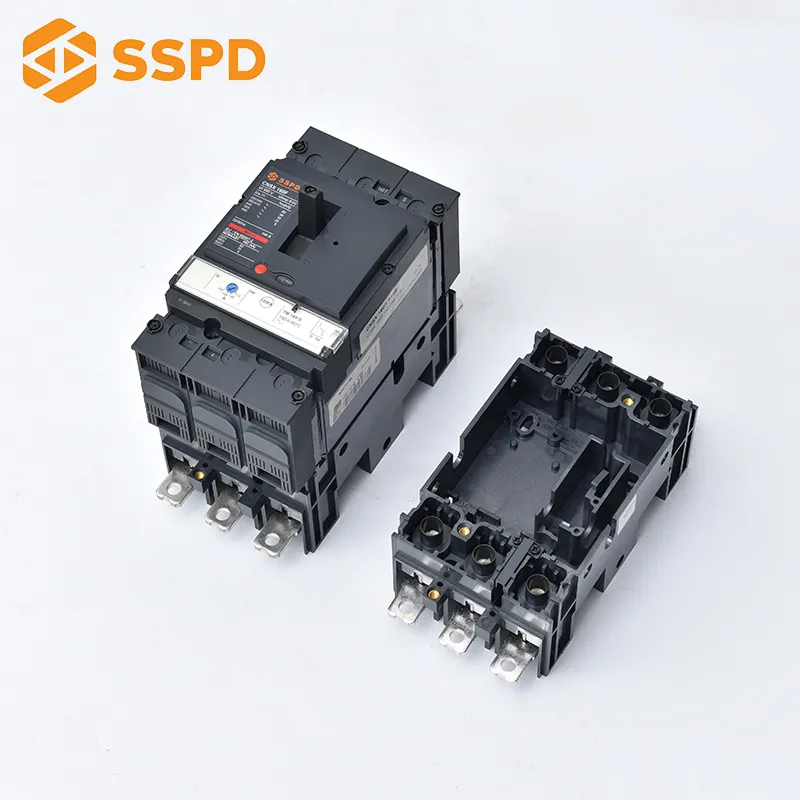
Which SSPD MCCB Series Can Be Used at 690V?
The correct answer depends on the individual series and frame.
SSPD MCCB Voltage Comparison
| SSPD Series | Rated Current | Ui | Ue | Suitable for 690V Operation? |
|---|---|---|---|---|
| CEZC | up to 630A | 690V | 440V | No |
| CNSX | up to 630A | model-dependent | verify by frame | Verify exact data before selection |
| CNSV | up to 630A | 690V | 440V in technical table | Do not treat as 690V unless data is reconfirmed |
| CNS 800–1600 | 800–1600A | 1000V | 690V | Yes |
For SSPD’s CNS 800–1600A series, the published technical data specifies Ue = 690V, with 3P and 4P configurations available. The series also provides separate breaking-capacity values for 660/690V operation.
This is exactly why buyers should evaluate the individual model rather than assume that every MCCB within the same brand or product family has the same voltage capability.
Breaking Capacity at 690V Must Be Checked Separately
This is probably the most important technical point after Ue.
Many buyers ask:
“Do you have a 50kA MCCB?”
But that question is incomplete.
The correct question is:
50kA at what voltage?
Breaking capacity can change significantly with system voltage.
An MCCB that has a high Icu at 400V or 415V may have a lower breaking capacity at 690V.
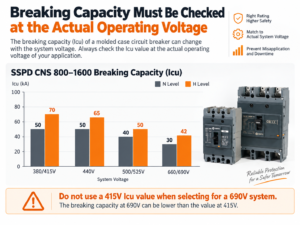
For example, the SSPD CNS 800–1600A series shows the following published breaking capacities:
| Operating Voltage | N Level | H Level |
|---|---|---|
| 380/415V | 50kA | 70kA |
| 440V | 50kA | 65kA |
| 500/525V | 40kA | 50kA |
| 660/690V | 30kA | 42kA |
This illustrates an important engineering principle:
Do not use the 415V breaking-capacity value when selecting an MCCB for a 690V system.
Always check the Icu and Ics values specifically at the actual operating voltage.
This is also consistent with established industrial MCCB practice: manufacturers publish different breaking-capacity values at different operating voltages rather than one universal kA value for every voltage level.
What Is the Difference Between Icu and Ics at 690V?
For a 690V system, both values are important.
Icu — Ultimate Short-Circuit Breaking Capacity
Icu is the maximum prospective short-circuit current that the MCCB can interrupt under the specified test conditions.
Ics — Service Short-Circuit Breaking Capacity
Ics indicates the fault current level the breaker can interrupt while remaining capable of continued service under the standard test sequence.
For project selection, you should compare the expected short-circuit current at the installation point against the manufacturer’s 690V Icu and Ics values, not the values shown only for 400V or 415V.
Internal link:
Read more: Icu vs Ics in MCCB — What Is the Difference and How Do You Choose?
Is a Higher Breaking Capacity Always Better at 690V?
Not necessarily.
A higher breaking capacity may provide additional margin, but selecting an unnecessarily high level can increase cost without adding practical value.
The correct method is:
- Determine the prospective short-circuit current.
- Check the MCCB’s Icu and Ics at 690V.
- Select a breaking capacity above the required fault level.
- Consider coordination with upstream and downstream protection.
For example, if the expected fault current is well below 30kA, selecting a 42kA or even higher breaker may provide additional margin, but the final decision should still consider selectivity, coordination and project economics.
Internal link:
Read more: Is a Higher MCCB Breaking Capacity Always Better?
Should You Use a 3P or 4P MCCB at 690V?
The voltage level alone does not determine the number of poles.
The correct pole configuration depends on the electrical system.
3P MCCB
Typically used where only the three phase conductors need switching and protection.
4P MCCB
May be required where the neutral conductor must also be switched or isolated, depending on:
- System configuration
- Grounding arrangement
- Project specifications
- Local electrical requirements
The SSPD CNS 800–1600A series is available in both 3P and 4P versions for 690V-class applications.
The final configuration should always follow the actual distribution system design rather than a general rule based only on voltage.
Thermal-Magnetic or Electronic Trip Unit for 690V?
Both types may be suitable depending on the application.
Thermal-Magnetic Trip
Suitable for applications where relatively simple overload and short-circuit protection is required.
Advantages include:
- Simpler configuration
- Lower cost
- Easy operation
Electronic Trip Unit
Often more suitable for larger industrial distribution systems because it can provide:
- Adjustable long-time protection
- Short-time protection
- Instantaneous protection
- Better coordination flexibility
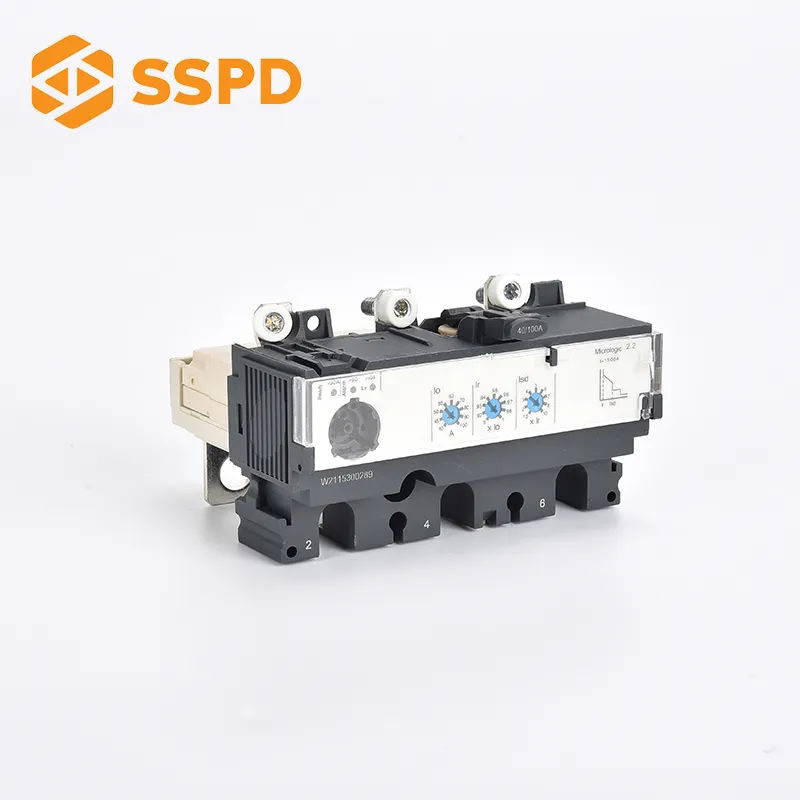
For SSPD CNS 800–1600A, the protection data includes long-time delay, short-time delay and instantaneous protection functions.
The choice should depend on the required protection coordination, not simply on the system voltage.
Example: Why a “400A 50kA MCCB” Is Not Enough Information
Consider a buyer who sends the following inquiry:
400A MCCB, 50kA, 3P.
At first glance, this looks complete.
But then the system voltage is confirmed as:
690V AC
Now the original request becomes incomplete.
The supplier must verify:
- Is Ue rated at 690V?
- Is the stated 50kA value valid at 690V or only at 415V?
- What is the Ics value at 690V?
- Is 3P correct for the distribution system?
- What trip unit is required?
- Is an MCCB still the correct device for the application and current level?
This is a common sourcing problem.
A buyer may compare quotations based on:
400A + 50kA
while two suppliers are actually quoting products with different voltage ratings and different fault-interruption capability at 690V.
That is why a complete technical comparison is more useful than comparing only the ampere and kA values shown in a quotation.
690V MCCB Selection Checklist
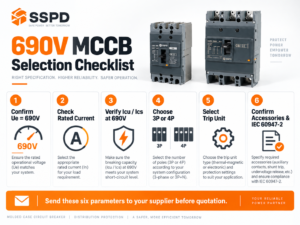
Before ordering an MCCB for a 690V system, confirm the following:
| Item to Check | What to Confirm |
|---|---|
| Rated operational voltage | Ue = 690V AC |
| Rated current | Suitable In for the actual load |
| Icu | Breaking capacity specifically at 690V |
| Ics | Service breaking capacity at 690V |
| Ui | Adequate insulation voltage |
| Uimp | Required impulse withstand level |
| Poles | 3P or 4P |
| Trip unit | Thermal-magnetic or electronic |
| Protection settings | Ir / Isd / Ii if applicable |
| Frequency | Usually 50/60Hz as specified |
| Installation conditions | Temperature, altitude, enclosure |
| Standard | IEC 60947-2 |
| Accessories | Shunt trip, undervoltage release, auxiliary contacts, rotary handle, etc. |
This checklist is usually more useful than asking only:
“Do you have a 690V MCCB?”
When Should You Consider an ACB Instead of an MCCB?
For higher-current main distribution applications, especially where:
- Current is very high
- Selectivity requirements are complex
- Drawout construction is required
- Advanced protection functions are needed
an ACB may be more suitable than an MCCB.
For example, SSPD’s MCCB range includes the CNS series up to 1600A, while higher-current main incomer applications may be better served by an air circuit breaker depending on the project design.
The decision should be based on:
- Current level
- Fault level
- Protection coordination
- Installation method
- Maintenance requirements
rather than simply assuming an MCCB is always the preferred option.
Frequently Asked Questions
Can every MCCB marked “690V” be used at 690V?
No. You must check what the 690V value represents. If it is only the rated insulation voltage Ui, that does not prove the breaker is rated for 690V operation. Confirm that the rated operational voltage Ue is 690V.
Can an MCCB with Ui 690V and Ue 440V be used at 690V?
No. For a 690V operating system, the breaker must have the appropriate rated operational voltage. Ui is not a substitute for Ue.
Does MCCB breaking capacity decrease at higher voltage?
It often does. Breaking capacity should always be checked at the actual system voltage. For example, SSPD CNS 800–1600A data shows lower breaking-capacity values at 660/690V than at 380/415V.
Can a 415V 50kA MCCB automatically be treated as 50kA at 690V?
No. A 50kA value stated at 415V does not automatically apply at 690V. Check the manufacturer’s voltage-specific Icu and Ics table.
Should I use a 3P or 4P MCCB for a 690V system?
It depends on the electrical system and neutral arrangement. Both 3P and 4P MCCBs can be used in appropriate 690V applications.
Which standard applies to industrial 690V MCCBs?
IEC 60947-2 is the key international standard for industrial low-voltage circuit breakers and covers rated AC voltages up to 1000V.
Summary
A 690V MCCB is a normal industrial application, but selecting one requires more than checking a single voltage value.
The most important points are:
- Confirm Ue = 690V
- Do not confuse Ui with Ue
- Check Icu and Ics specifically at 690V
- Confirm the correct rated current
- Select the correct pole configuration
- Choose the appropriate trip unit
- Verify IEC 60947-2 compliance
For SSPD products, CEZC should not be treated as a 690V operating MCCB because its Ue is 440V, while the CNS 800–1600A series is rated for Ue 690V and provides published 690V breaking-capacity data.
CTA
Need Help Selecting an MCCB for a 690V System?
Send us:
- System voltage
- Rated current
- Expected short-circuit current
- Required poles
- Trip-unit requirement
- Application or single-line diagram if available
The SSPD team can help review the required MCCB configuration before quotation.
Author
Jimmy Zheng
International Business Manager at SSPD
Jimmy has more than 10 years of experience in low-voltage electrical products and international B2B business. He works with electrical distributors, switchgear manufacturers and industrial buyers on MCCB, ACB and circuit-protection selection.
Technical Review:
SSPD Engineering Team
Reviewed for technical accuracy, product specifications and applicable low-voltage circuit-breaker standards.