Should I Choose a Thermal-Magnetic or Electronic MCCB?
Quick Answer
Choose a thermal-magnetic MCCB when you need reliable overload and short-circuit protection with a simpler design and lower cost. Choose an electronic MCCB when the system requires wider adjustable protection settings, better coordination, higher setting flexibility, or additional monitoring functions. Neither type is always better—the correct choice depends on the protection requirements of the electrical system.
Both technologies are widely used in molded case circuit breakers. Thermal-magnetic trip units provide established overload and short-circuit protection, while electronic trip units provide greater flexibility for protection settings and system coordination. ABB, for example, describes thermal-magnetic MCCBs as an economical and dependable solution for overload and short-circuit protection.
What Is a Thermal-Magnetic MCCB?
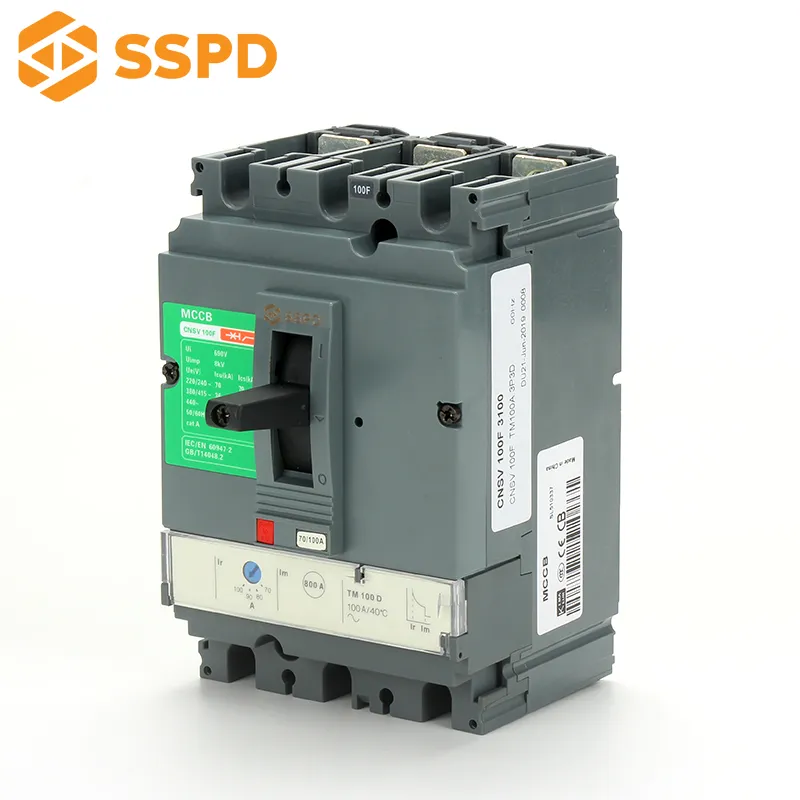
A thermal-magnetic MCCB uses two different tripping mechanisms to protect the circuit.
The thermal element responds mainly to overload conditions. When excessive current flows for a period of time, heat causes the thermal mechanism to operate and trip the breaker.
The magnetic element responds much faster to high short-circuit currents. When the current rises sharply above the magnetic trip threshold, the breaker opens rapidly to interrupt the fault.
This combination makes thermal-magnetic MCCBs suitable for many standard low-voltage distribution applications where the main requirements are:
- Overload protection
- Short-circuit protection
- Simple operation
- Proven reliability
- Competitive cost
Thermal-magnetic designs remain common in switchboards, motor control centers, power panels and general distribution systems. ABB specifically positions this type as a reliable and cost-effective protection solution for overloads and short circuits.
Main advantages of a thermal-magnetic MCCB
- Relatively simple protection principle
- Lower cost in many applications
- Suitable for standard distribution
- Easy for distributors and maintenance teams to understand
- No complex electronic configuration required
However, adjustment capability depends on the specific trip unit. Some thermal-magnetic units offer limited adjustable settings, while others are largely fixed.
What Is an Electronic MCCB?
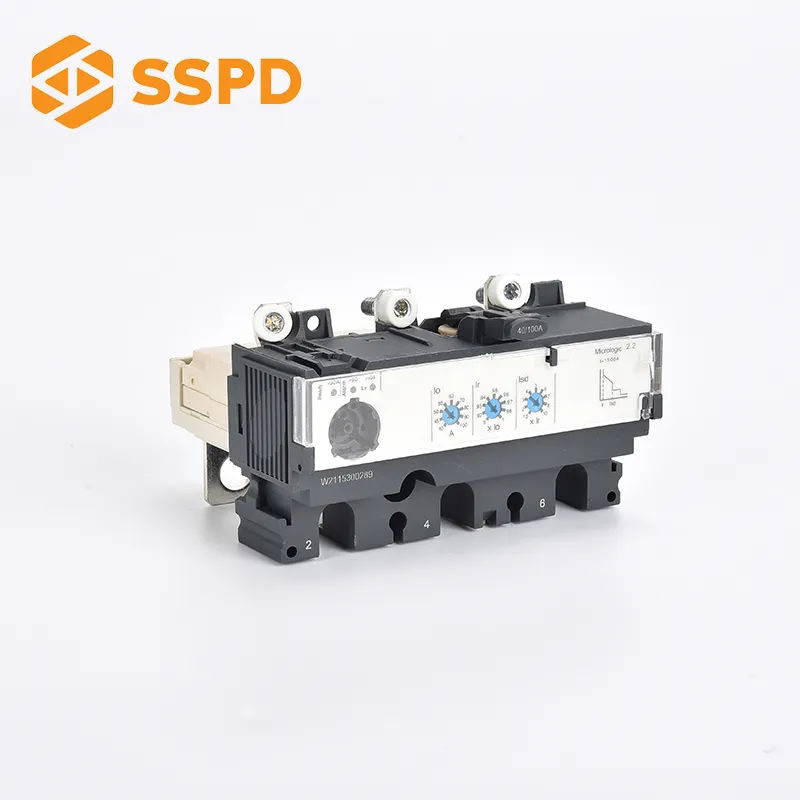
An electronic MCCB uses current sensing and an electronic trip unit to determine when the circuit breaker should operate.
Instead of relying only on the physical response of a thermal element, the electronic trip unit processes current information and applies configured protection settings.
Depending on the MCCB and trip unit, these settings can include functions such as:
- Long-time protection
- Short-time protection
- Instantaneous protection
- Ground-fault protection
- Adjustable current thresholds
- Adjustable time delays
- Metering or monitoring
- Communication functions
Not every electronic MCCB includes all of these functions. The actual capability depends on the trip-unit model.
The important difference is flexibility.
Electronic trip units allow system designers to tune breaker behavior more precisely to the electrical network instead of relying mainly on fixed or relatively limited trip characteristics.
Low-voltage circuit breakers of this type fall within the broader circuit-breaker framework covered by IEC 60947-2, whose current 2024 edition applies to circuit breakers for circuits up to 1,000 V AC under its principal scope.
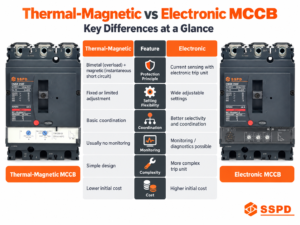
Thermal-Magnetic vs Electronic MCCB: Key Differences
| Factor | Thermal-Magnetic MCCB | Electronic MCCB |
|---|---|---|
| Overload protection | Yes | Yes |
| Short-circuit protection | Yes | Yes |
| Setting flexibility | Limited to moderate | Usually wider |
| Protection adjustment | Simpler | More configurable |
| Time-delay adjustment | Limited / model dependent | Often available |
| Selective coordination | More limited | Better suited to complex coordination |
| Monitoring | Usually not available | Available on some trip units |
| Communication | Usually no | Available on advanced models |
| Complexity | Lower | Higher |
| Initial cost | Usually lower | Usually higher |
| Typical use | Standard distribution | Complex industrial distribution |
| Best choice when | Basic protection is sufficient | Protection flexibility is important |
The table should be treated as a general selection guide rather than a rule for every MCCB. Actual features depend on the specific breaker and trip-unit configuration.
When Should You Choose a Thermal-Magnetic MCCB?
A thermal-magnetic MCCB is often the more practical choice when the electrical system is relatively straightforward.
Typical examples include:
- Standard distribution boards
- Commercial electrical systems
- General industrial feeders
- Small and medium machinery
- Applications with uncomplicated protection requirements
- Cost-sensitive projects
Suppose a factory has a 250A feeder supplying ordinary production equipment, and the system does not require complicated breaker coordination, communication or detailed protection adjustment.
In this situation, an appropriately rated thermal-magnetic MCCB may already provide the protection required.
Adding a sophisticated electronic trip unit may increase cost without creating significant operational value.
This leads to an important purchasing principle:
Do not pay for protection functions that the electrical system does not require.
Electronic protection is more advanced, but “more advanced” does not automatically mean “more suitable.”
When Should You Choose an Electronic MCCB?
Electronic MCCBs become more valuable as the electrical system becomes more complex.
They are particularly useful when you need:
1. More adjustable protection settings
If engineers need to change pickup levels or time delays to match cables, loads or downstream breakers, electronic protection gives greater flexibility.
2. Better coordination between breakers
In a multi-level distribution system, engineers may want the breaker closest to the fault to trip first while upstream breakers remain closed.
Electronic trip settings make this easier to engineer.
3. Critical-load protection
Production lines, infrastructure, data-related facilities and other critical electrical systems may place a higher value on controlled protection behavior and reduced unnecessary shutdowns.
4. Monitoring or communication
Advanced electronic trip units may provide current measurements, operating information, alarms or communication capabilities.
5. Large main distribution systems
Main incoming breakers and larger distribution feeders often require more careful coordination with upstream and downstream protection.
In these situations, an electronic MCCB may provide significantly more engineering flexibility.
Quick Selection Matrix
| Application | Typical Choice | Main Reason |
|---|---|---|
| Small distribution board | Thermal-magnetic | Simple and economical |
| Commercial distribution | Thermal-magnetic | Basic protection usually sufficient |
| Standard factory feeder | Thermal-magnetic or electronic | Depends on coordination needs |
| Main industrial distribution | Electronic | Greater setting flexibility |
| Multi-level distribution system | Electronic | Better coordination capability |
| Critical production process | Electronic | More precise protection control |
| System requiring monitoring | Electronic | Additional measurement functions possible |
| Cost-sensitive standard project | Thermal-magnetic | Avoid unnecessary complexity |
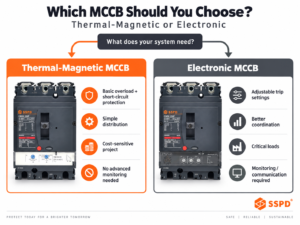
There is no universal rule saying that one trip-unit technology should be used at a particular current rating. The protection requirements of the system should determine the choice.
Example 1: Standard Factory Feeder
Consider a simple industrial feeder with the following conditions:
- System voltage: 400 V AC
- Feeder current: approximately 200–250 A
- Load: general production equipment
- No communication requirement
- No complex selective coordination requirement
The engineering priorities are:
- Reliable overload protection
- Reliable short-circuit protection
- Appropriate breaking capacity
- Reasonable purchasing cost
For this type of application, a thermal-magnetic MCCB may be entirely adequate.
The buyer should therefore focus on selecting:
- Correct rated current
- Correct breaking capacity
- Suitable number of poles
- Suitable accessories
rather than automatically upgrading to an electronic trip unit.
If you are unsure about MCCB current selection, see our guide:
[What Size MCCB Do I Need? How to Calculate the Correct MCCB Rating]
Example 2: Main Industrial Distribution Panel
Now consider a main distribution board supplying several downstream feeders.
The system may require:
- Adjustable long-time protection
- Short-time protection
- Coordination with downstream MCCBs
- Controlled fault isolation
- Future system expansion
In this situation, an electronic MCCB becomes much more attractive.
The higher purchase cost should not be evaluated in isolation.
If improved protection coordination prevents one downstream fault from unnecessarily shutting down a larger part of the facility, the additional functionality may provide meaningful operational value.
This is why MCCB selection should be based on system requirements rather than breaker price alone.
Is an Electronic MCCB Always Better?
No.
This is one of the most common misunderstandings when comparing MCCBs.
An electronic trip unit normally provides more flexibility, but it can also mean:
- Higher purchasing cost
- More configuration requirements
- Greater technical complexity
- Features that may never be used
If an application only requires standard overload and short-circuit protection, a thermal-magnetic MCCB may be the more rational choice.
The correct question is therefore not:
Which MCCB is more advanced?
It is:
Which protection functions does my electrical system actually require?
Are Electronic MCCBs More Accurate?
Electronic trip units generally provide greater setting precision and repeatability than traditional thermal-magnetic mechanisms, particularly where engineers need adjustable pickup levels and time-delay characteristics.
However, buyers should not select an electronic MCCB based on the word “accuracy” alone.
Protection performance also depends on:
- Trip-unit design
- Breaker quality
- Installation conditions
- Correct settings
- System coordination
- Manufacturer specifications
A poorly configured electronic MCCB is not automatically better than a correctly selected thermal-magnetic MCCB.
Common Mistakes When Choosing Between the Two
Mistake 1: Assuming Electronic MCCBs Are Always Better
More functions do not necessarily mean better value.
Match the breaker to the system.
Mistake 2: Choosing Thermal-Magnetic Only Because It Is Cheaper
Price should not override protection requirements.
If coordination or adjustable protection is required, saving money on the trip unit may create problems later.
Mistake 3: Ignoring Breaking Capacity
Trip-unit type and breaking capacity are different selection issues.
Whether the MCCB uses thermal-magnetic or electronic protection, its breaking capacity still needs to be suitable for the prospective short-circuit current.
For more detail:
[How to Choose MCCB Breaking Capacity: 18kA, 25kA, 36kA, 50kA or Higher?]
and:
[Icu vs Ics in MCCB: What Is the Difference and How Do You Choose?]
Mistake 4: Ignoring Coordination
For multi-level distribution systems, choosing every breaker independently can create poor selectivity.
Upstream and downstream devices should be considered as part of the same protection system.
Mistake 5: Buying Features That Will Never Be Used
Communication, monitoring and advanced protection functions can be valuable—but only when the project uses them.
A distributor should also consider what the end customer actually needs before recommending a higher-specification configuration.
What Should Buyers Confirm Before Ordering?
Before requesting a quotation for an MCCB, confirm at least the following:
- Rated current
- Frame size
- Number of poles
- System voltage
- Required breaking capacity
- Thermal-magnetic or electronic trip unit
- Required protection functions
- Adjustment range
- Required accessories
- Communication requirements, if any
This is particularly important when comparing quotations.
Two MCCBs may have the same:
250A / 3P / 36kA
basic description but use very different trip units.
Their prices should therefore not be compared until the protection configuration has also been confirmed.
This is a common source of confusion in international MCCB procurement.
How Does Trip Unit Selection Fit Into the Complete MCCB Selection Process?
The trip unit is only one part of selecting an MCCB.
A complete selection should normally consider:
- Load current
- Rated current
- System voltage
- Prospective short-circuit current
- Breaking capacity
- Protection requirements
- Trip-unit type
- Coordination
- Accessories and installation conditions
You can see the complete process in:
[How to Select the Right MCCB for Industrial Applications]
Also remember that higher breaking capacity is not automatically better for every project:
[Is a Higher MCCB Breaking Capacity Always Better?]
Frequently Asked Questions
What size MCCB do I need?
What is the difference between MCCB and MCB?
How do I choose MCCB breaking capacity?
What is the difference between Icu and Ics?
Can an MCCB be used at 690V?
Is a higher breaking capacity always better?
Conclusion
There is no universal winner between thermal-magnetic and electronic MCCBs.
Choose thermal-magnetic protection when simplicity, reliability and cost are the main priorities. Choose electronic protection when the electrical system requires greater adjustment flexibility, coordination or monitoring.
The best MCCB is not the one with the most functions—it is the one whose protection characteristics match the electrical system.
About the Author
Jimmy Zheng
International Business Manager at SSPD
Jimmy Zheng has more than 10 years of experience in low-voltage electrical products and international B2B business. He works with electrical distributors, switchgear manufacturers and industrial buyers on MCCB, ACB, motor protection and low-voltage circuit protection applications.
Technical Review
SSPD Engineering Team
This article has been reviewed for technical accuracy, MCCB protection principles and product-selection logic.
About SSPD
SSPD manufactures low-voltage circuit protection products for distributors, switchgear manufacturers and industrial customers worldwide.
If you are comparing thermal-magnetic and electronic MCCBs for a project, you can provide your rated current, voltage, breaking-capacity requirement and application, and the SSPD team can help review the appropriate configuration.