What Do Ir, Isd and Ii Mean on an MCCB Trip Unit?
By Jimmy Zheng | International Business Manager at SSPD
Quick Answer: What Do Ir, Isd and Ii Mean?
On an electronic molded case circuit breaker (MCCB), Ir typically refers to the long-time overcurrent pickup setting, Isd to the short-time pickup setting, and Ii to the instantaneous pickup setting. These parameters define the current thresholds at which different protection functions operate. Their adjustment ranges and calculation methods depend on the specific trip unit, so always consult the manufacturer’s technical documentation before configuring a breaker.
Why Do MCCB Trip Unit Settings Matter?
Choosing an MCCB based only on its rated current does not guarantee adequate circuit protection. The trip unit settings determine how the breaker responds to overloads and short circuits, influencing equipment protection and coordination with other circuit breakers.
For electrical engineers, switchgear manufacturers and industrial buyers, understanding Ir, Isd and Ii helps clarify product specifications, evaluate electronic trip units and communicate protection requirements accurately when sourcing MCCBs.
1. What Does Ir Mean on an MCCB?
Ir is the long-time overcurrent pickup setting, primarily associated with overload protection.
An overload occurs when a circuit carries more current than intended for a sustained period. Unlike a short circuit, an overload may develop gradually, but excessive current can still cause conductors and connected equipment to overheat.
The Ir setting establishes the current threshold used by the long-time protection function. When current exceeds the applicable threshold, the trip unit follows its long-time operating characteristic to determine when to trip.
What Is the Difference Between In and Ir?
These two symbols should not be confused.
- In: Commonly identifies the rated current of the breaker or the reference rating of a trip unit or sensor, depending on the manufacturer’s terminology.
- Ir: Identifies the long-time pickup setting on trip units that use this designation.
On some trip units, Ir is adjustable as a fraction or multiple of a reference current. Other designs use additional settings, such as Io, to establish the pickup value.
For this reason, the equation used to calculate Ir must come from the applicable product manual rather than from a universal assumption.
What Is tr?
The symbol tr refers to the long-time delay setting on trip units that provide this adjustment.
Ir and tr perform different functions:
- Ir determines the long-time current pickup threshold.
- tr determines the applicable long-time delay characteristic.
The actual tripping time depends on the trip unit’s time-current characteristics and the magnitude of the overcurrent. It should not be inferred from Ir alone.
2. What Does Isd Mean on an MCCB?
On trip units with a separate short-time protection function, Isd is the short-time overcurrent pickup setting.
Short-time protection is designed to respond to short-circuit currents above the long-time protection region. Depending on the trip unit, the breaker may apply a deliberate delay before tripping.
This delay can help coordinate upstream and downstream protection devices. For example, in a properly engineered distribution system, a downstream breaker may be allowed to clear a fault first, reducing the likelihood of unnecessarily disconnecting a larger section of the installation.
What Is tsd?
The symbol tsd generally identifies the short-time delay setting.
The two settings serve different purposes:
- Isd defines the short-time current pickup threshold.
- tsd defines the applicable short-time delay.
Some trip units offer adjustable short-time delay settings, while others use fixed characteristics or provide different protection configurations. The available options must be checked against the relevant technical manual.
How Is Isd Related to Ir?
On many electronic trip units, Isd is expressed as a multiple of Ir. However, the available multipliers and calculation basis are product-specific.
If a manual specifies that Isd equals a selected multiplier multiplied by Ir, the calculation follows that documented relationship.
This relationship must not be assumed for every MCCB. Some trip units use different terminology or do not provide a separately adjustable short-time protection function.
3. What Does Ii Mean on an MCCB?
Ii typically identifies the instantaneous overcurrent pickup setting.
Instantaneous protection is intended to respond rapidly when current reaches a specified high-current threshold, commonly associated with severe short-circuit conditions.
Unlike a protection function with an intentional time delay, instantaneous protection does not intentionally wait for a separately selected delay before initiating a trip. However, the breaker still has a physical operating and interruption time.
Is Ii Adjustable?
It depends on the trip unit.
Some electronic trip units allow the instantaneous pickup threshold to be adjusted. Other designs use a fixed threshold, while certain configurations may provide different options.
The presence of an instantaneous protection function does not automatically mean that its threshold is user-adjustable.
What Is the Relationship Between Isd and Ii?
On trip units that provide both short-time and instantaneous protection, the two functions serve different roles:
- Isd: Short-time pickup, potentially with a deliberate delay.
- Ii: Instantaneous pickup, without an intentional delay.
Their settings affect how the breaker responds to different fault-current levels and how it coordinates with other protection devices.
The relationship between their thresholds must be evaluated using the actual trip-unit characteristics. Do not assume that every product requires the same numerical relationship or adjustment sequence.
4. Ir vs Isd vs Ii: What Is the Difference?
The following table summarizes their typical meanings on electronic MCCB trip units that provide these three separate functions.
| Parameter | Protection function | Main purpose | Related time setting |
|---|---|---|---|
| Ir | Long-time overcurrent | Overload protection | tr |
| Isd | Short-time overcurrent | Short-circuit protection with an applicable short-time characteristic | tsd |
| Ii | Instantaneous overcurrent | Rapid response to high short-circuit current | No intentional delay setting |
The important distinction is that Ir, Isd and Ii are current pickup parameters, whereas tr and tsd are time-related settings.
Not every MCCB has all three functions, and the terminology may differ between trip-unit designs. Always confirm the labels and functions shown in the specific product documentation.
5. Example: How Are MCCB Trip Settings Calculated?
Consider a hypothetical electronic trip unit with a reference current of 400 A.
For illustration only, assume its manual specifies the following relationships:
- Ir = 0.8 × the reference current
- Isd = 5 × Ir
- Ii = 10 × the reference current
The calculations would be:
| Parameter | Calculation | Illustrative result |
|---|---|---|
| Ir | 0.8 × 400 A | 320 A |
| Isd | 5 × 320 A | 1,600 A |
| Ii | 10 × 400 A | 4,000 A |
These values demonstrate how documented setting multipliers can be converted into current thresholds.
This is an illustrative calculation, not an SSPD product setting or a recommendation for an actual installation. The assumed multipliers are not universal. Before calculating settings for a real MCCB, confirm the reference current, available adjustment range, pickup accuracy and time-current characteristics in the applicable technical manual.
The final settings must also be evaluated against the load, conductor protection requirements, prospective short-circuit current and coordination study.
6. How Do These Settings Affect Protection Coordination?
In an industrial distribution system, a breaker must protect the circuit while working appropriately with other protective devices.
Several factors need to be considered:
Load characteristics: The long-time pickup must be suitable for the protected circuit and its operating conditions.
Conductor protection: The protection settings must be compatible with the conductors’ current-carrying capacity and applicable installation requirements.
Prospective short-circuit current: The selected breaker must have suitable interruption capability for the installation point.
Selectivity: The time-current characteristics of upstream and downstream devices should be evaluated to determine whether a fault can be isolated as close to its source as practicable.
Equipment requirements: Motors, transformers and other equipment may have starting or inrush currents that influence protection coordination.
No single Ir, Isd or Ii setting is appropriate for every installation. Protection settings should be determined by a qualified electrical engineer using the relevant product documentation and system study.
7. How Do These Settings Apply to SSPD MCCBs?
SSPD offers MCCBs across different frame sizes and product configurations. However, trip-unit functions and adjustment options must be assessed by series and configuration rather than assumed to be identical across the product range.
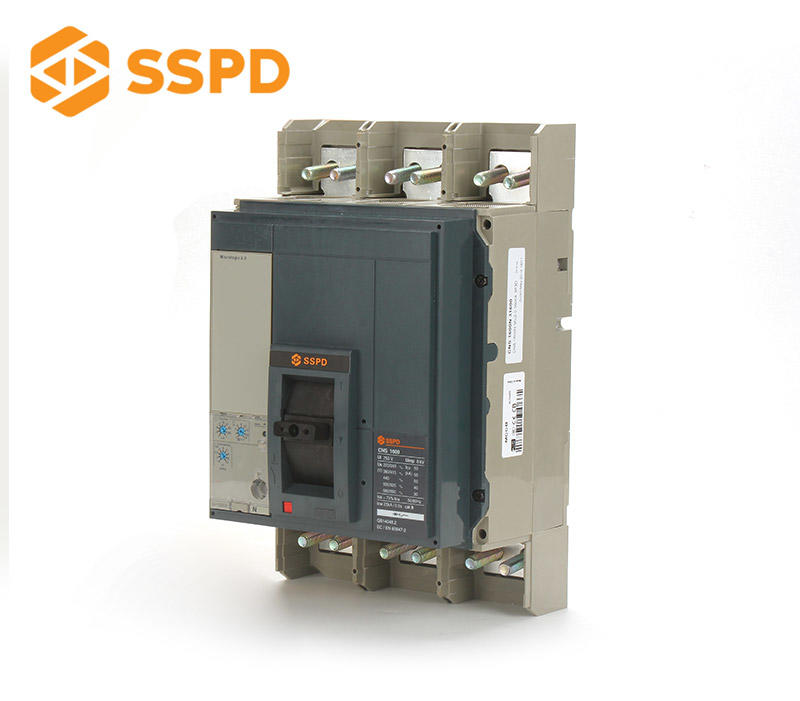
The SSPD product catalogue identifies electronic trip-unit options for the CNS 800–1600A MCCB series, including long-time, short-time and instantaneous protection settings designated Ir, Isd and Ii, depending on configuration.
When evaluating this series, buyers should confirm the following with the applicable product documentation:
- The exact electronic trip-unit configuration.
- The reference current used for each adjustment.
- The available Ir, Isd and Ii setting ranges.
- Whether long-time and short-time delays are adjustable.
- The relevant time-current curves and protection characteristics.
- The required breaking capacity and coordination requirements.
For other SSPD MCCB series, including CNSX and CEZC, buyers should verify the specific trip-unit configuration before assuming that the same three settings are available.
You can explore the SSPD MCCB product range for product information and configuration options.
8. Common Mistakes When Reading MCCB Trip Units
Mistake 1: Confusing In with Ir
The reference or rated current and the long-time pickup setting are not necessarily identical. Their relationship depends on the trip-unit design.
Mistake 2: Treating Isd as the Same as Ii
Where both functions are available, short-time and instantaneous protection have different operating characteristics. They should not be treated as interchangeable.
Mistake 3: Assuming Every MCCB Has All Three Settings
Some MCCBs use thermal-magnetic trip units, while electronic trip units differ in their available functions. The labels and adjustment options must be confirmed for the specific model.
Mistake 4: Copying Settings from Another Project
A setting suitable for one installation may be unsuitable for another because load conditions, short-circuit levels, conductor requirements and coordination objectives differ.
Mistake 5: Choosing a Breaker by Current Rating Alone
A suitable MCCB must also meet the system’s voltage, breaking-capacity and protection requirements.
Frequently Asked Questions
What is the difference between Ir and In?
In commonly identifies a breaker or trip-unit reference rating, while Ir identifies the long-time pickup setting on trip units that use this designation. The precise relationship depends on the product.
Is Isd the same as instantaneous current?
Not necessarily. On trip units with separate short-time and instantaneous functions, Isd normally refers to short-time pickup and Ii to instantaneous pickup. Some trip-unit designs use different terminology, so the manual must be checked.
What is the difference between Isd and Ii?
Isd typically defines the short-time pickup threshold, which may have an associated delay. Ii typically defines the instantaneous pickup threshold, which operates without an intentional delay.
Are Ir, Isd and Ii adjustable on every electronic MCCB?
No. Adjustment options depend on the trip-unit model. Some parameters may be adjustable, fixed or unavailable on a particular configuration.
Can I use the same MCCB settings for every installation?
No. Settings must be evaluated against the actual load, conductor protection, prospective short-circuit current, equipment requirements and coordination objectives.
How can I confirm the correct settings for an SSPD MCCB?
Identify the exact MCCB series and trip-unit configuration, then consult its applicable technical documentation. Confirm the reference current, adjustment ranges, time-current curves and protection functions before determining the settings for an installation.
Conclusion
Ir, Isd and Ii typically represent long-time, short-time and instantaneous current pickup settings on electronic MCCB trip units. Understanding their differences helps engineers and buyers evaluate protection functions, interpret product specifications and ask more precise technical questions.
Because trip-unit terminology and adjustment ranges vary between products, the correct settings must always be confirmed against the applicable documentation and the requirements of the electrical installation.
If you are selecting an SSPD MCCB for an industrial distribution project, contact our team with your required current rating, system voltage and protection requirements to discuss a suitable product configuration.
About the Author
Jimmy Zheng
International Business Manager at SSPD
Jimmy Zheng has more than 10 years of experience in low-voltage electrical products and international B2B business. His work focuses on MCCB, ACB, MCB and AC contactor solutions for electrical distributors, switchgear manufacturers and industrial buyers. His articles cover product selection, technical communication and practical considerations in international electrical procurement.
Technical Review
SSPD Engineering Team
Technical review should confirm the terminology, calculations, product-series references and any model-specific statements before publication.
Technical Reference
For general requirements applicable to low-voltage circuit breakers, refer to the official IEC 60947-2 standard page.
This standard provides the broader product-standard framework for circuit breakers. It does not establish one universal set of Ir, Isd and Ii adjustment values for every manufacturer’s trip unit. For actual settings, always consult the technical documentation for the exact MCCB and trip-unit configuration.